Toyota TRUST Project Uses Traffic Data to Refine Bangkok Road Safety Measures
Toyota’s TRUST project combines traffic data and local observations to target risks in Bangkok, then monitors whether site changes help or create new hazards.
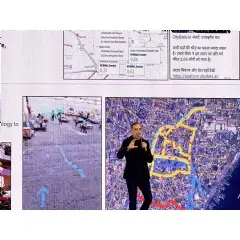
At Ratchada Soi 32, Bangkok’s TRUST project is testing a useful idea for road safety: treat near-misses and risky traffic interactions as evidence, then check what happens after changes go in. The first round of measures included cones and new road markings. Follow-up observations have also raised a possible downside, with some motorcycles slowing sharply near the cones before turning. That’s why monitoring is central to the work, not an afterthought.
The Toyota Mobility Foundation (TMF) presented the project’s progress at Thailand Smart City Expo 2026 on November 18 and at the 17th Thailand Road Safety Seminar. Pras Ganesh, TMF’s Executive Program Director, outlined how data analysis and emerging technologies can help identify risks earlier, guide targeted changes and assess their effects. The approach is being developed in Bangkok with the aim of sharing a method that can be adapted elsewhere.
Looking beyond crash records
Launched in April 2025, TRUST brings together TMF, Bangkok Metropolitan Administration (BMA), UN-Habitat, Asian Institute of Technology (AIT), Toyota Motor Thailand Co., Ltd. (TMT) and Road Accident Victims Protection Co., Ltd. (RVP). Its analysis looks across three connected areas: people, roads and infrastructure, and vehicles.
The project combines vehicle probe data, drone and video analytics, and observations made on site. That mix lets the team examine how road users interact with each other and with the street layout, including potentially hazardous situations that may never appear in crash records. Indicators such as Time-to-Collision (TTC) and Post-Encroachment Time (PET) can flag interactions for closer review.
Ganesh described the technology as a way to make traffic safety analysis more objective and reveal patterns that conventional observation might miss. He also stressed that local knowledge and human perspectives remain necessary to understand what road users are experiencing. The working method, then, is to combine analytical evidence with people’s knowledge of a location, validate likely causes and develop countermeasures suited to that site.
Three sites, different data tools
In Bangkok’s Chatuchak district, TRUST selected three trial blackspots in consultation with BMA and AIT: Wat Samian Naree School (G2), the Ratchada-Lat Phrao intersection (G4), and Ratchada Soi 32 (G5). Each location has its own physical conditions and traffic patterns, so the project uses different collection and analysis methods.
At G2 and G4, GoPro or CCTV footage is analyzed with Transoft Solutions software. At G5, the team uses drone footage analyzed with DataFromSky. Across the trial sites, the project has moved from identifying blackspots and examining root causes to implementing measures with stakeholders and monitoring the results.
What the Ratchada Soi 32 trial has shown
At Ratchada Soi 32, the analysis focused on vehicles merging and diverging near the side-street entrance. A drone survey in December 2025 recorded almost 4,000 vehicles passing during a 30-minute morning peak; motorcycles made up approximately 62% of traffic. Video analysis, combined with site observations, helped the team study how vehicles moved between the main road and the side street.
After reviewing the findings with relevant stakeholders, BMA introduced several traffic-management and road-marking measures. Traffic cones were placed to discourage last-minute lane changes. Blue “Turn Left” markings and approach signage were added, along with a solid line on the main road near the side-street exit to discourage lane changes there.
Early observations suggest that some motorcycles may slow sharply before reaching the cones when preparing to turn into the side street. That could create a rear-end risk for following vehicles. The team plans to examine the observation through a formal evaluation using comparable data sources. Until that assessment is complete, it remains a potential unintended effect rather than a confirmed outcome.
This is the kind of feedback loop the project is designed to support: identify a risk, make a location-specific change, observe how traffic responds and refine the measure if the evidence points to a new or continuing hazard. Toyota applies a similar safety-management principle in manufacturing, where unsafe acts and near-misses can be identified before they lead to serious incidents.
A method intended to travel
TRUST aims to share its methodology, analytical approach and lessons with public agencies and project partners so they can consider applying them in other districts and provinces. The longer-term ambition is a road-safety model that can be adapted to local conditions, piloted in Bangkok, replicated across Thailand and shared more widely.
The project grew from discussions among mobility companies and organizations at the Tateshina Meeting in Japan, where participants considered road-safety challenges. Its findings are also being considered for future activities under KUB-DEE-DAI-DEE (KDDD), or “Drive Good, Earn Good,” a joint BMA, Honda and TMF campaign launched in November 2025 that encourages safer driving through positive reinforcement.
For TRUST, the practical test is whether data and local experience can help teams choose better-targeted measures, then spot unintended effects early enough to respond. The Ratchada Soi 32 trial shows why that second step matters: a road change needs to be judged by what drivers actually do after it is installed.
About Toyota Mobility Foundation
Established in August 2014 by Toyota Motor Corporation, Toyota Mobility Foundation supports the development of a more mobile society in which everyone can move freely. It works with universities, public bodies, non-profits, research institutions and other organizations on mobility programs aligned with the UN Sustainable Development Goals. Further information is available from the Toyota Mobility Foundation.


