FCC Innovation Day Puts AI, Climate-Ready Infrastructure and Circular Materials in Focus
FCC’s fifth Innovation Day featured AI, waste recovery, climate-adapted port design and projects from its business areas and partners.
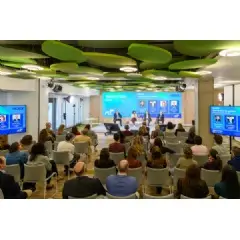
Applied innovation across FCC’s businesses
FCC’s fifth Innovation Day brought its business areas, employees and external partners together around a practical question: how can new ideas address the company’s current and future challenges? Held at the Group’s corporate headquarters in Las Tablas, the event ranged from artificial intelligence and sustainability to circular economy projects and climate adaptation. Its strongest thread was the connection between technical development and the work of FCC’s different businesses.
The programme was promoted by the Group’s Digital Innovation Lab, or DILab. Alfredo García, FCC Group Systems and IT Director, and Manel Miranda, Corporate Innovation Director, opened the event. García’s systems and technology remit and Miranda’s innovation role framed a day that moved between data projects, infrastructure design, materials research and ideas developed by employees.
A session titled “From data to impact: AI initiatives at FCC” put artificial intelligence on the agenda. Pilar de Vicente, the Group’s Data & AI Director, and Miranda presented the main AI initiatives currently being developed at FCC. The session’s title points to the practical test facing these projects: data work matters when it can inform decisions or help deliver results in the company’s businesses. The event account doesn’t specify individual applications or report performance figures, so the focus remained on the initiatives in development.
Materials, climate adaptation and resource recovery
Several of the featured projects linked innovation to the physical demands of operating infrastructure and processing materials. Cementos Portland Valderrivas presented SYNGAS, a project focused on recovering waste as an energy source for cement production. Joan Carles Izquierdo, Director of the Monjos and Vallcarca plants, introduced the work. The concept connects two industrial processes: material that would otherwise be treated as waste can serve as an energy input, with the stated aim of contributing to more sustainable cement production.
FCC Construcción’s CLIMPORT project addressed another long-term engineering challenge: designing and building port infrastructure adapted to climate change. Nuria Cotallo Agudo, Head of the company’s Maritime Works Department, presented the modelling system. For port projects, modelling can help bring changing climate conditions into the design process; CLIMPORT’s stated purpose is to support that adaptation. The presentation did not provide design parameters or specific project results.
FCC Construcción also presented research and development work on low-carbon products based on geopolymer mortars. Pablo Narro, Project Manager for the Doha Metro Red Line at FCC Construcción and Project Director at FCC Concesiones, presented the initiative. Its focus on mortar makes the materials question tangible: construction products are part of how infrastructure is built, and developing lower-carbon options is one route the company is exploring. No mix specifications or measured emissions reductions were given.
Together, these examples show the range of work under the event’s sustainability theme. SYNGAS concerns energy recovery in cement production; CLIMPORT concerns climate-aware infrastructure design; and the geopolymer work concerns construction materials. Each project addresses a different point in the lifecycle of industrial or infrastructure work, rather than treating sustainability as a single technical problem.
Business-area perspectives and employee ideas
A round table, “Sustainability ‘without labels’ (Innovate, transform, endure),” brought together leaders from across the Group. Javier López-Galiacho, FCC Group Compliance and Sustainability Director, moderated the discussion. The participants were Antonio Burgueño, Sustainability and Innovation Director at FCC Construcción; Eva Egido, Compliance, Safety and Sustainability Director at FCC Environment; and Pedro Luis Rodríguez Medina, Sustainability and Innovation Director at Aqualia. The conversation explored how innovation, transformation and sustainability relate to the different businesses represented.
Aqualia also had a presentation from Innovation Director Víctor Monsalvo on innovation as a driver of competitiveness and leadership. That business perspective sat alongside FCC Environment’s research and development presentation by Global R&D&I Director Juan Gorriti. Rather than one central technology defining the day, the programme gave several business areas room to present work tied to their own operations.
Internal talent had its own place on the agenda through Roota, FCC’s intrapreneurship programme. DILab and finalist teams took part in the programme’s awards ceremony. The format gives employees a route to bring forward ideas from within the organisation, extending the event’s focus beyond established projects and external technologies.
Sara García Alonso, a researcher at Spain’s National Cancer Research Centre and a reserve astronaut with the European Space Agency, shared her experience in science and research. She spoke about taking on new challenges and highlighted preparation, commitment and teamwork. Her contribution brought a perspective from scientific research to a programme otherwise centred on the Group’s business projects.
Exhibition floor connects projects and partners
The exhibition area let attendees see examples from FCC Group and Inmocemento business areas alongside work from partner companies. FCC Environment displayed PROSPER, focused on technologies for bioplastics recycling, and ATLAS, a 3D monitoring solution. Aqualia showed nature-based solutions, while FCC Construcción presented digital urban infrastructure and digital twin projects. The Systems and Technology Division contributed Data & AI solutions.
External exhibitors included Microsoft with “The Agentic Experience: Where Data meets Agents”; Acuilae, which showcased 3D printing, prototyping and robotics; and Casual Robots, with its Luna and G1 humanoid robots. The mix put software, physical prototyping and robotics beside projects in water, construction and environmental services. That arrangement made collaboration and knowledge sharing a visible part of the event, while giving attendees a chance to encounter technologies in practical demonstrations.
Miranda closed the fifth edition after a programme spanning business presentations, research, employee-led ideas and demonstrations. The clearest takeaway is the breadth of FCC’s innovation work: from recovering waste for cement production to modelling ports for climate adaptation, the projects are tied to different operational needs. Their next measure will be how the work develops within those businesses.


