Ford GT41: The 5.4-Litre V8 Hypercar Chasing Le Mans in 2027
Ford’s GT41 pairs a naturally aspirated 5.4-litre V8 with hybrid power as it prepares to challenge for outright Le Mans victory in 2027.

Ford’s GT41 brings the company back to Le Mans’s top class with a new car, a naturally aspirated 5.4-litre V8 and a target that needs no embellishment: outright victory in 2027. The hypercar made its public debut at Ford Field in Detroit on November 26, during the Thanksgiving Day NFL game. Its first racing season starts in Qatar in March, with the 24 Hours of Le Mans following in June.
The name nods to the GT40 while reflecting the new car’s proportions. The original GT40 took its name from its 40in height; the GT41’s air intake sits 41in above the ground under current Hypercar regulations. Its powertrain combines a Ford Coyote-derived V8 with a hybrid system. Ford has not supplied output figures, so the more revealing detail for now is how the engine is being developed and built.
A new car against established rivals
Ford enters a Hypercar field where nine rival manufacturers have already been competing for several seasons. Ferrari has won the Le Mans 24 Hours three years in a row since 2023. Ford’s global director of Ford Racing, Mark Rushbrook, calls the timing a “massive challenge”: Ford is bringing an all-new car while some rivals are bringing updated versions of established machinery.
The pressure carries a long memory. In 1963, Enzo Ferrari withdrew from a proposed purchase deal with Ford because he would not give up control of his racing department. Henry Ford II responded by setting his sights on beating Ferrari at Le Mans. The GT40 programme grew from that resolve, with development in England at Ford Advanced Vehicles in Slough, based on Eric Broadley’s Lola Mk6.
The first attempts were rough. No GT40 finished Le Mans in 1964 or 1965. Then, in June 1966, GT40 Mk2s filled the first three places. Shelby American and Holman Moody ran the cars, each powered by a 7.0-litre V8. The result ended Ferrari’s six-year winning streak, though the staged formation finish denied Ken Miles the victory he appeared poised to claim: Bruce McLaren and Chris Amon were declared winners because their car had started farther back on the grid. Miles died while testing the Mk2’s successor at Riverside on August 17, 1966.
The Mk4 connection, built into the engine programme
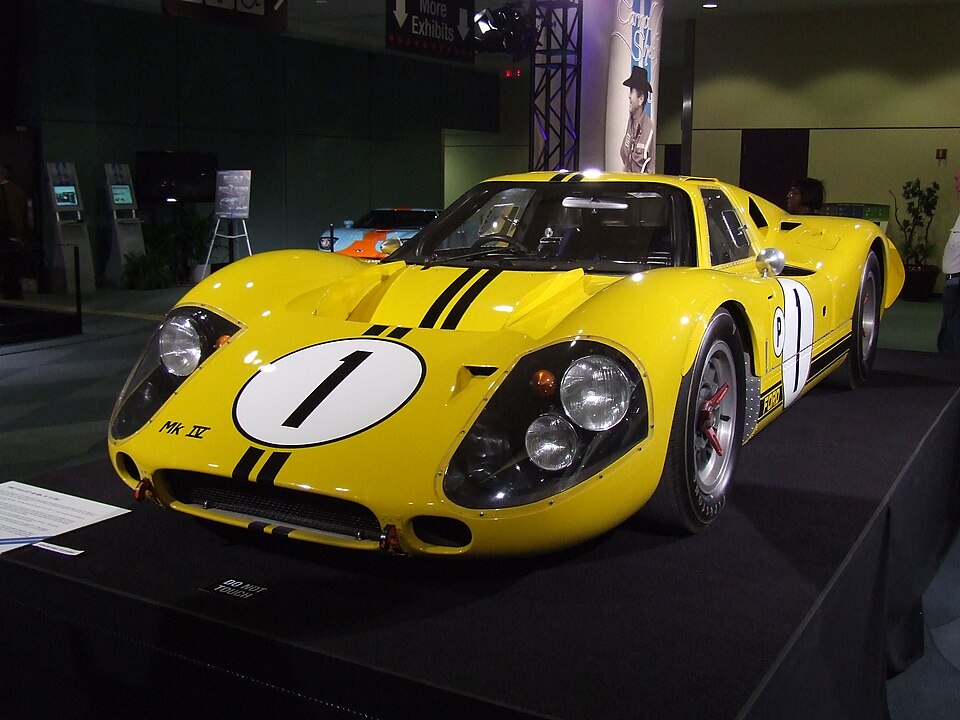
The closest historical counterpart to the GT41 may be the GT40 Mk4, a car conceived in 1965 by Ford’s Special Vehicles Activity and built in Dearborn. Its bonded aluminium honeycomb chassis drew on aerospace construction. The Mk4 won at Sebring on its debut, then took Le Mans on June 10–11, 1967. Dan Gurney and AJ Foyt Jr averaged 135.7mph with a 500bhp, 427ci V8. Ford chief archivist Ted Ryan describes that achievement as significant because the car was American built, American designed and American raced.
Ford is pursuing a similar degree of in-house control with the GT41’s engine. Ford engineers designed the V8, and two builders, Ben Johnson and Kyle Stevens, assemble each unit by hand. Their workspace occupies an 800sq ft room converted from two decommissioned test cells in the company’s 1949 dynamometer building. It sits 20ft from the cell where engines for the 1960s Le Mans programme were developed.
Each engine takes more than two weeks to assemble, starting with a block cast on Ford’s production line in Windsor, Ontario. Stevens said the first build marked the first hand-assembled engine in that room in many years. Some components are made using newer processes: the oil pump housing is metal-printed in Dearborn, drawing on work developed with Red Bull Ford Powertrains in Formula 1.
Track development also mixes modern tools with the old discipline of testing hardware under load. Ford has not previously raced a hypercar at Le Mans, so engineers run the circuit in a North Carolina simulator, then replay those laps on the dynamometer while the engine runs. The process lets the powertrain face simulated La Sarthe running before the car has raced there.
Past winners, new crew
Ford’s Le Mans record extends beyond the 1966 sweep. After rule changes ended the big-engined prototypes’ run, John Wyer’s Gulf-liveried GT40 Mk1, chassis 1075, won in 1968 and 1969. The 1968 race was postponed until September amid unrest in France; Pedro Rodríguez and Lucien Bianchi took the win. A year later, Jacky Ickx and Jackie Oliver beat Hans Herrmann’s Porsche 908 by seconds.
The GT41 crew has experience of its own. Mike Rockenfeller won Le Mans outright with Audi in 2010, while reserve driver Tom Dillmann is a two-time class winner. Sebastian Priaulx brings a family connection to Ford’s more recent return: his father, Andy Priaulx, drove the number 67 Ford GT in 2016, when Ford came back 50 years after its 1-2-3 and won the GTE Pro class. “My dad unfortunately didn’t get to win Le Mans, but the Ford did,” Sebastian says. “Hopefully, we can.”
Testing toward the first start
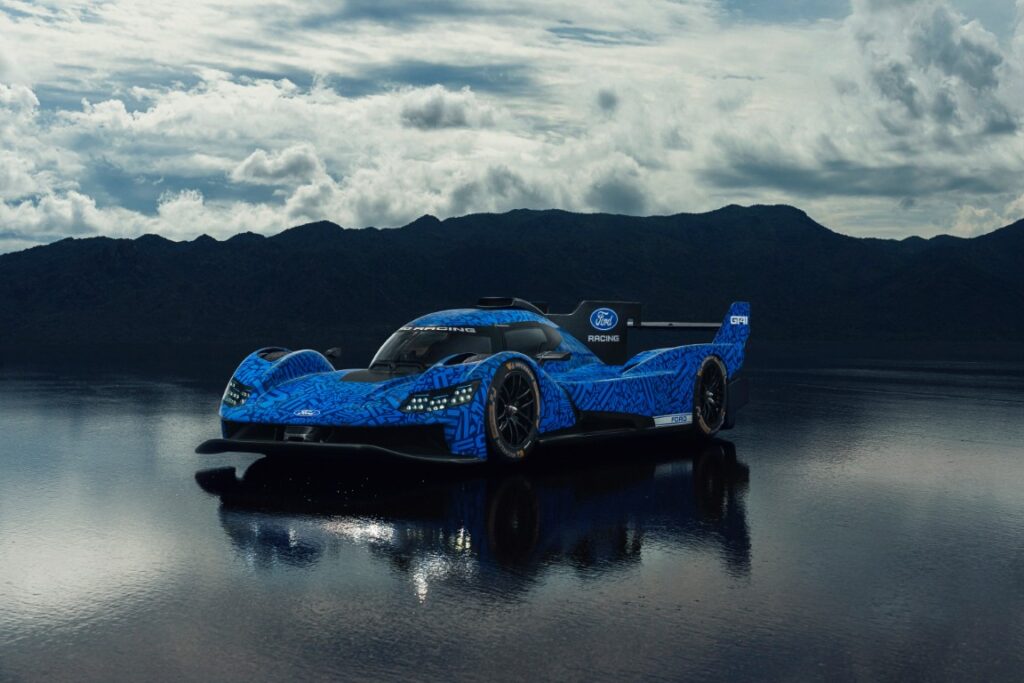
The GT41’s blue-on-blue prototype livery includes a hidden reference to Detroit’s Spirit of Detroit sculpture. That detail ties the car to the city where Henry Ford beat Alexander Winton at Grosse Pointe on October 10, 1901, two years before founding Ford Motor Company. Executive chair Bill Ford links the race to the company’s beginnings: “Ford’s racing history began 125 years ago when my great-grandfather won a race that helped him found Ford Motor Company.”
The car has completed its European test programme and is due to continue running in the United States during December and January. Its racing debut is scheduled for Qatar in March, followed by Le Mans in June, 60 years after Gurney and Foyt’s 1967 win. Ford has plenty of history to draw on; the work now is to turn a hand-built V8, hybrid system and all-new chassis into a car that can earn its place beside those earlier winners.