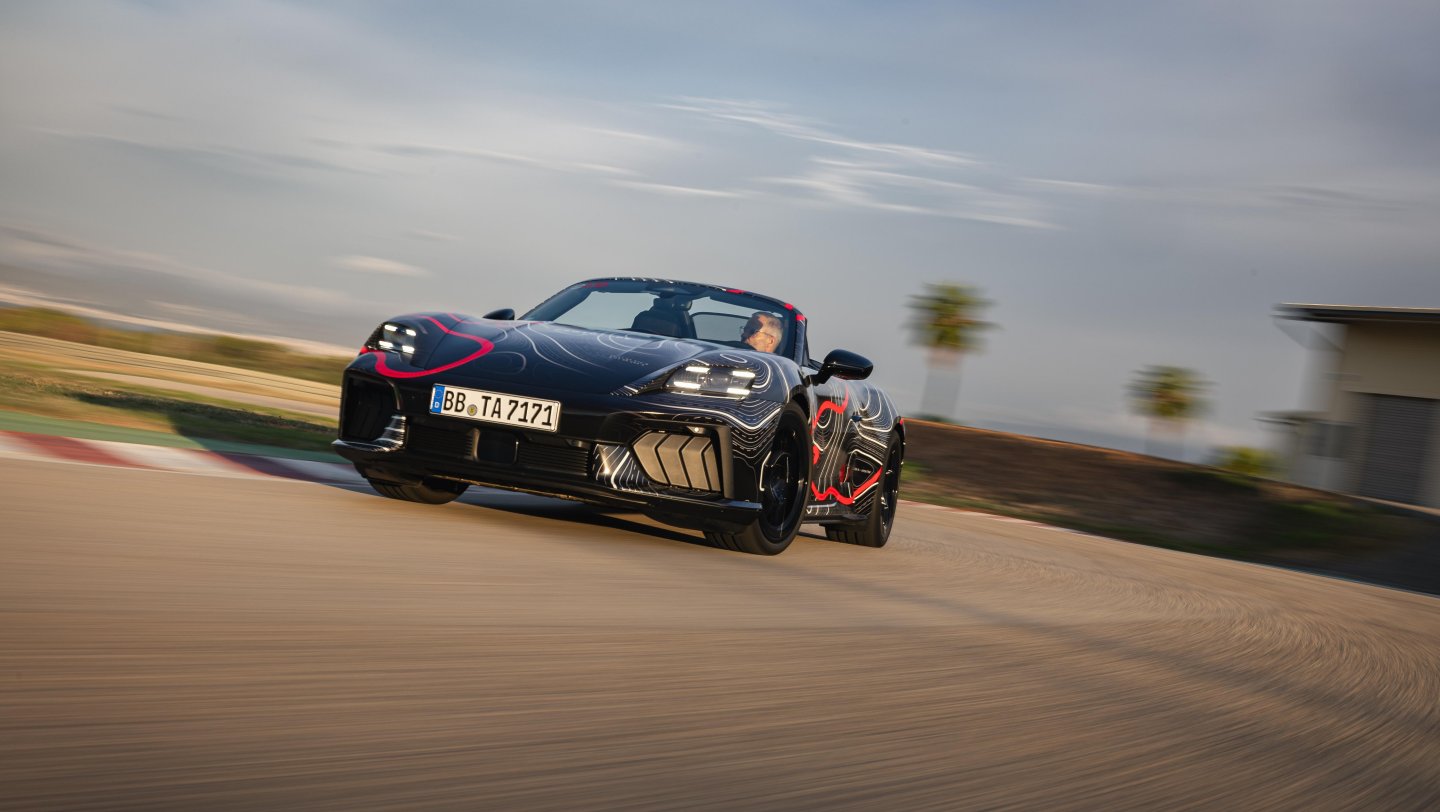
Electric Porsche 718 Boxster Nears Production After Four Million Kilometres of Testing
Porsche’s electric Boxster pairs a mid-engine-style layout with rear-wheel drive, 800-volt hardware and a virtual seven-speed shift mode.
The electric 718 Boxster’s defining engineering choice is where Porsche has put its battery. The 800-volt pack sits directly behind the seats, in the space used by the combustion engine in earlier Boxsters. Porsche calls this layout E-Core, and says it preserves a low seating position and concentrates weight near the middle of the car. The figures are 40 per cent of the weight on the front axle and 60 per cent on the driven rear axle, a split aligned with the traditional mid-engined sports-car layout.
That packaging decision matters because the Boxster’s character depends on more than acceleration. A low seat and centrally concentrated mass shape the driver’s position and the way the car responds to steering and changes of direction. Porsche says lightweight construction keeps the electric car’s overall weight similar to current 911 Cabriolet models equipped with the T-Hybrid powertrain. It has not provided a curb weight, battery capacity or motor output, so those details remain unknown.
The development team has put the prototypes through about four million kilometres of testing across more than 20 countries. Conditions ranged from Swedish ice and snow at temperatures as low as -30 degrees Celsius to Death Valley heat reaching 51 degrees Celsius. Test routes ran from 86 metres below sea level to 2,750 metres above it. The team also checked charging performance against five different charging standards, while urban driving in Las Vegas, Los Angeles and Shanghai put everyday usability and driver assistance systems under scrutiny.
Chassis hardware with 911 connections
Porsche has drawn on the 911 for several chassis components. The steering is based on the 911 Carrera GTS, while the wheel and tyre dimensions and braking system also take their cues from the larger sports car. An electronically controlled PTV+ limited-slip differential is another 911-derived component. Rear-axle steering, available on the 718 Boxster for the first time, adds a new tool to the model’s handling setup.
Those parts give a clearer picture of the car’s intended character than the headline acceleration figure alone. The rear axle carries 60 per cent of the stated weight and supplies the drive, while the differential manages torque between the rear wheels. Rear-axle steering can influence how the car responds through a corner, and the chosen steering and braking hardware connects the Boxster’s development to Porsche’s established sports-car components. The company hasn’t yet described the suspension tuning or supplied detailed brake specifications.
Virtual gears, real driver controls
Every electric 718 Boxster will come with E-Shift, a system that can reproduce the feel of a seven-speed PDK through virtual shifts. Drivers can leave changes to the automatic mode or use paddles behind the steering wheel for manual shifts. The shift behaviour changes with the selected driving mode, and Porsche says a targeted torque increase during each shift makes performance identical whether E-Shift is active or not.
With E-Shift engaged, the car also plays a recreated six-cylinder boxer sound based on the 981-generation Boxster GTS. When the system is off, the paddles control three stages of recuperation instead. That dual role gives the driver a choice between simulated gear changes and adjusting energy recovery from the steering wheel. It also shows how Porsche is trying to retain familiar sports-car cues in a car whose propulsion doesn’t require conventional gear changes.
Two-time World Rally Champion Walter Röhrl praised the prototype’s power, braking, handling and feedback, and said activating E-Shift increased the driving enjoyment. His comments are an individual assessment, but they point to the development target Porsche is emphasizing: a connected driving experience, with the shift simulation acting as one part of the car’s character rather than a route to higher performance.
Performance and timing
The range-topping model is expected to accelerate from rest to 100 km/h in less than three seconds and reach a top speed above 250 km/h. Porsche says every version will be rear-wheel drive, and describes the electric 718 Boxster as the most powerful 718 yet. No horsepower, torque, battery range or charging-rate figures have been released, leaving the prototype’s stated performance benchmarks as the clearest numerical guide for now.
Porsche Chairman Dr Michael Leiters says the car is intended to offer an entry point into the company’s two-door sports-car range starting next year. The company plans to build the electric 718 Boxster at its main plant in Stuttgart-Zuffenhausen, with a world premiere scheduled for the first quarter of 2027. That timing places the model’s debut after the current development programme’s final stretch; Porsche has not provided a customer delivery date.
The engineering story to watch is whether the production car keeps the prototype’s unusual blend of mid-engined packaging, rear-wheel drive and simulated PDK shifts. The E-Core layout is the foundation: it sets the seating position and weight distribution, while the 911-linked chassis parts and configurable paddles shape how that foundation reaches the driver. Porsche’s next opportunity to show those choices in detail will be the planned world premiere.
===