How Lenovo’s Computing Infrastructure Supported Marc Márquez’s 2026 MotoGP Comeback
Lenovo’s expanded computing setup helped Ducati analyze race data, develop the Desmosedici GP during Márquez’s absence and prepare for 2027.
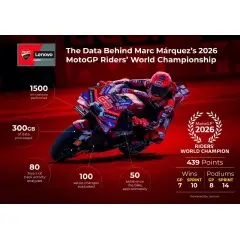
Marc Márquez’s 2026 MotoGP Riders’ World Championship came after a 102-point deficit and injuries that disrupted the opening part of his season. Lenovo says its computing infrastructure helped Ducati Corse keep developing the Desmosedici GP during Márquez’s absence and make faster, data-informed setup decisions when he returned. The title was clinched at the Portuguese Grand Prix.
The technical contribution was measured in computing capacity and turnaround time. An expanded High-Performance Computing (HPC) system developed through Ducati and Lenovo’s collaboration added around 48% more processing power and roughly doubled available memory. That headroom let engineers handle more data and simulations as they worked on the bike through the season.
Race weekends leave little time for analysis
MotoGP data arrives in short bursts: engineers can review a rider’s latest running after the bike comes back to the garage, while another track session may be close. Lenovo workstations, edge servers and HPC infrastructure gave Ducati the processing, storage and connectivity to compare telemetry with Márquez’s impressions and identify possible adjustments inside that limited window.
That comparison matters because the numbers don’t explain themselves. Braking traces, throttle application, corner speed and lean angle can show where a lap differs, but engineers still need the rider’s account of how the motorcycle behaved. Working through both sources quickly gives the crew a better basis for deciding which setup changes merit attention before the next outing.
Development continued while Márquez was sidelined
After Márquez crashed at Le Mans, Ducati’s remote garage in Bologna kept the engineering work moving. Specialists processed existing data, ran simulations and collaborated with the trackside crew despite having no new laps from him to study. The aim was to assess potential changes while keeping the bike’s performance, predictability and familiar feel in view for his eventual return.
Once Márquez was back on track, engineers used Lenovo technology to compare his pre-injury and post-injury running. They considered his telemetry alongside his feedback and comparisons with other Ducati riders, giving the team context for judging both his progress and the motorcycle’s response.
Simulation helped narrow the list of changes before track testing. If a possible solution could be ruled out in advance, Márquez didn’t need to spend laps investigating it. That made the return-to-riding process more structured and saved time during sessions, when every run has to produce useful information.
From the 2026 title to the next Desmosedici
The season’s data is also feeding development of the 2027 Desmosedici GP. Ducati Corse is using Lenovo-powered analysis and simulations to examine which motorcycle characteristics can work across different riders, circuits and conditions. That work will inform development as the team approaches the regulation changes scheduled for 2027.
For Luca Rossi, Lenovo’s President of Intelligent Devices Group, Márquez’s win—the Ducati Lenovo Team’s fourth Riders’ Championship in five years—shows what close collaboration can achieve. He said the season’s competition and technical challenges called for teamwork and the ability to turn data into decisions, adding that Lenovo technology supported the team’s performance and preparation for MotoGP’s next era.
Ducati Motor Holding CEO Claudio Domenicali credited Márquez’s talent and determination alongside the work of the wider team. He described technology and human performance as complementary, and said Lenovo’s support helped Ducati make informed decisions and improve performance through the season.
The result puts a clear shape on the partnership’s role: computing capacity supported rapid garage analysis, development while Márquez was injured and a measurable comparison when he returned. The next test of that work is already underway in the data—how the 2026 experience translates into a 2027 bike that can perform across riders and track conditions.
About the teams
Lenovo is a global technology company with reported annual revenue of US$83 billion and customers in 180 markets. Its products and services span personal devices, workstations, servers, storage, edge computing, HPC, software and services. The company is listed on the Hong Kong stock exchange as Lenovo Group Limited (HKSE: 992; ADR: LNVGY). More information is available at Lenovo.com.
Founded in 1926, Ducati develops and builds motorcycles at Borgo Panigale in Bologna, Italy, and competes in MotoGP and WorldSBK. The company marks its centenary in 2026 and sells motorcycles in more than 90 countries. Its official site is Ducati.com.


