Rolls-Royce Silver Ghost at 120: The 40/50 H.P. That Set a Lasting Standard
The 40/50 H.P. earned its Silver Ghost name through engineering, endurance runs and owner stories that still shape Rolls-Royce’s reputation.
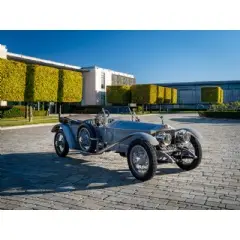
The Rolls-Royce Silver Ghost earned its reputation on the road, where smooth running and dependable performance could be judged over long distances. Its 120th anniversary puts the 40/50 H.P. back in view: a car whose endurance results mattered, but whose lasting hold on owners also came from comfort, careful engineering and the confidence it inspired.
A name that grew beyond one car
Rolls-Royce first presented the 40/50 H.P. at London’s Olympia Motor Show in November 1906. It was among the most advanced cars of its era, with a smooth-running six-cylinder engine and a level of dependability that answered some of early motoring’s mechanical uncertainties. Henry Royce’s attention extended beyond the engine to the car’s components, refinement and handling.
Claude Johnson, the company’s first Commercial Managing Director, understood that those qualities needed to be demonstrated as well as described. He gave individual cars distinctive names. Chassis 60551, finished in silver paint with silver-plated fittings, became “The Silver Ghost.” The name caught on among owners of other 40/50 H.P. cars, and eventually came to identify the whole model range. The story of the model and its name is also told in Rolls-Royce’s account of the 1910s Silver Ghost.
Proof built into the miles
Under Johnson’s direction, the 40/50 H.P. took on demanding trials and competitions. Its record included the Scottish Reliability Trial, the London-Edinburgh run, victory in the Spanish Grand Prix and success in the Austrian Alpine Trial. These events gave prospective owners visible evidence of how the car performed over sustained use, when reliability carried real weight.
Chassis 1701, known as “The Sluggard,” remains one of the best-known examples. On the 1911 London-Edinburgh Trial, it completed the run with its gearbox locked in top gear, exceeding the fuel economy and speed figures previously achieved by Napier. Later that year, it became the first Rolls-Royce to exceed 100 mph. The car is now displayed at the Home of Rolls-Royce at Goodwood.
Those demonstrations had practical force. At a time when driving was still a relatively new pursuit, buyers making a substantial outlay wanted evidence that a car could cover serious distances without constant mechanical trouble. Trial results helped make the Silver Ghost’s reputation tangible.
Owners and observers made the case
Contemporary praise came from both motoring commentators and people who lived with the cars. The Dundee Chronicle described Rolls-Royce as “a standard of design that is in a class of its own”; Country Life called it “The quintessence of all that a car ought to be.”
One owner reported covering 30,000 miles on French roads without engine trouble. In an account reproduced in Punch, the owner praised the car while acknowledging that Derby had likely heard similar compliments before. W. H. Johnson was more succinct in an interview with The Financial News: “I know there is now a perfect car.” These remarks point to the same qualities as the competition record, but from the owner’s seat: a car that remained composed and trustworthy over use.
The model drew owners from business and the arts, including aviation pioneer and yachtsman Tommy Sopwith, Paris Singer, Baron Alfred de Rothschild, shipbuilder Lord Pirrie, composer Sir Hubert Parry, Sir Winston Churchill and American aviator and film producer Howard Hughes. In 1911, eight landaulette-bodied Silver Ghosts were used during the celebrations surrounding King George V and Queen Mary’s visit to India. Rolls-Royce supplied drivers for the occasion, another sign of the trust placed in the cars’ reliability and discretion.
Comfort became part of the story
Some of the most telling evidence of the Silver Ghost’s character comes from private journeys. Opera singer Dame Nellie Melba took delivery of her 1911 car, chassis 1500, at the Ritz Hotel in London. She used it in Britain, France and Australia, where its comfort and dependability suited her extensive travels.
In Australia, Charles H. Angas called his car “The Dreamer” because his wife regularly fell asleep during rides. It’s a small, personal detail, but a useful one: the car’s smoothness wasn’t only a talking point at trials or in reviews. Passengers felt it over ordinary miles, too.
The Silver Ghost also gave Rolls-Royce one of its best-known visual symbols. Lord Montagu of Beaulieu’s car was the first to carry the Spirit of Ecstasy, sculpted by Charles Sykes and introduced as the marque’s official mascot in 1911.
A century of use, not just remembrance
In The Edwardian Rolls-Royce (Fasal & Goodman, 1994), the third Lord Montagu of Beaulieu described the Silver Ghost as technically sophisticated without seeming too adventurous. He praised the range of coachwork and its balance of lightness, strength and restraint, concluding that its era had passed but the standards it set for quality and luxury remained.
Owners have continued to put those cars to work on historic routes. In 2013, 47 Silver Ghosts retraced the 1,800-mile course of the 1913 Alpine Trial, including chassis 1701 and one of the original team cars. In 2021, chassis 1701 repeated the London-Edinburgh journey with its gearbox locked in top gear, echoing its 1911 run.
That continued use is a fitting measure of Henry Royce’s engineering. The Silver Ghost’s reputation grew from competition results, contemporary praise and the experiences of owners who trusted it over long journeys. At 120, its strongest legacy is the standard those miles established: refinement and reliability designed to be enjoyed on the road, not simply admired in the showroom.


