Audi A2 e-tron Drive Details: SiC Inverter, APP350 Motor and Efficiency Changes
The Audi A2 e-tron pairs a SiC inverter with a revised APP350 motor and transmission to cut losses, extend range and quiet the cabin.
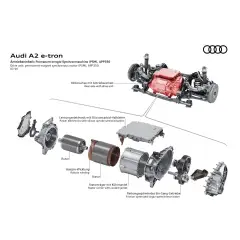
The Audi A2 e-tron’s efficiency story comes down to a series of changes across its electric drive: a silicon-carbide pulse inverter, a revised permanent-magnet motor and a transmission tuned to each power level. Audi says the combined updates reduce energy losses in the operating conditions that matter in everyday driving, while also improving cabin acoustics. The figures and hardware details point to a coordinated MEB drive revision rather than a single efficiency fix.
SiC power electronics target everyday use
Mounted at the rear, the APP350 permanent-magnet synchronous motor sits parallel to the axle and operates on a 400-volt system. It can deliver up to 350 Nm of torque. Its pulse inverter manages the handoff between the battery’s direct current and the alternating current needed by the motor, adjusting energy flow in response to sensor data.
The inverter’s power semiconductors are a key part of that process. The A2 e-tron uses silicon-carbide MOSFETs in a newly developed pulse inverter, replacing the silicon-based bipolar transistors described as standard in the predecessor setup. Audi cites inverter efficiencies above 97 percent, with silicon carbide’s switching characteristics helping reduce losses as the inverter changes the current supplied to the motor.
A software function varies the switching frequency to suit the drive’s operating point. Lower switching frequency can mean lower losses, and the adaptive strategy is designed to make use of that advantage in typical city and rural-road driving, where speeds and loads are moderate. That focus matters: efficiency gains in common partial-load conditions can contribute to real-world range without relying on peak output figures alone.
Audi also says improved energy use in the power electronics lets the system supply full power at low battery charge levels. The inverter has an acoustic role, too. It selectively adds high-frequency harmonic components to the motor current to counter disruptive tones, with the adjustment depending on the operating point. That puts noise control into the drive’s electrical operation rather than treating cabin sound as a separate issue.
APP350 changes address losses and motor tone
The APP350 is a further development of the MEB drive, replacing the APP310 predecessor. Audi’s changes cover the rotor, stator and winding arrangement, with the stated aim of improving efficiency without compromising torque or power delivery.
The rotor is more than 30 percent thinner than the APP310’s. That reduces iron losses, which occur as magnetic fields repeatedly remagnetize the motor’s material. It’s a detail that speaks to the drive’s broader approach: reduce losses within components that operate continuously, rather than depending only on a larger battery to deliver more range.
Rotor segments are arranged in a staggered pattern instead of a straight line. Audi says the revised layout avoids exciting the rotor’s first torsional mode and nearly eliminates dominant tonal components, especially when pulling away from a standstill. For drivers, the intended result is a quieter cabin during one of the moments when electric-drive sounds can be most noticeable.
The stator winding also moves from a star to a delta configuration, while the number of parallel branches is reduced. According to Audi, those changes improve motor efficiency, particularly at partial load. That aligns the motor revisions with the inverter’s adaptive strategy: both are aimed squarely at the speeds and loads common in routine use, not just maximum output.
Two gear ratios suit the available power levels
The compact transmission uses different ratios according to the APP350’s output. The 125 kW and 140 kW versions use a 10.21 ratio; the 170 kW version uses 11.53. Audi says each ratio is selected to keep motor speed within more efficient areas of its operating map. The available details don’t specify acceleration or top-speed figures, but they do show that the transmission is calibrated around the distinct power variants rather than using one ratio across the range.
Gear tooth finishing and lubrication complete the mechanical side of the efficiency work. Fine machining creates smoother tooth flanks, reducing friction as the gears mesh. It also permits a specially developed, low-viscosity transmission oil. Together with revised oil routing, the thinner oil is intended to reduce churning losses as the gear set moves through it.
The package makes a practical case for looking beyond the motor’s headline torque figure. In the A2 e-tron, the inverter’s switching behavior, rotor design, winding layout, gear ratio and lubricant all contribute to the drive’s operating efficiency. Audi presents the result as lower consumption, longer range and quieter operation; the specific range and consumption figures aren’t provided here. For buyers comparing the 125, 140 and 170 kW versions, the key technical distinction is that the transmission ratio changes with output, while the core APP350 drive and its efficiency updates underpin the lineup.


