Opel Corsa GSE Takes 2026 Golden Steering Wheel With 281 hp and 5.5-Second 0–100 km/h Run
The 281 hp electric Corsa GSE wins its class, pairing a 5.5-second sprint with everyday hatchback practicality and a long Opel award history.
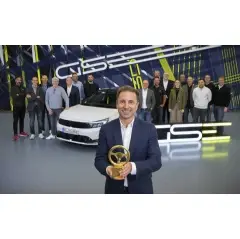
The new Opel Corsa GSE has earned the 2026 Golden Steering Wheel in the Best Small Car category, giving Opel’s electric hot hatch a win built on both pace and usable-car credentials. Its 207 kW (281 hp) output matches the Mokka GSE, but the smaller Corsa gets to 100 km/h in 5.5 seconds, making it the quickest accelerating current production Opel. The award adds another performance model to a line of Opel winners that reaches back to the Senator A in 1978.
That combination of speed and everyday utility is the Corsa GSE’s central pitch. Opel describes GSE as “Grand Sport Electric,” and the Corsa brings the badge into the familiar territory of a compact hot hatch: brisk acceleration, a lowered chassis, a limited-slip differential and enough room for ordinary errands. The car is already available to order. It also carries forward a performance tradition Opel has previously expressed through small, quick models such as the Corsa GSi and Kadett GTE, now with an electric powertrain.
A hot hatch judged on more than its launch
Readers of AUTO BILD and BILD am SONNTAG voted the Corsa GSE into the award final. At DEKRA Lausitzring, an expert jury then put the finalists through testing and evaluation. The Opel finished with 4,261 points, ahead of its competitors. Its strongest areas were launch behaviour, acceleration, power delivery and agility. The jury also rated it well for visibility, seating position and practicality, a useful reminder that a small performance car still has to work when the road gets crowded or the trip gets longer.
A lowered chassis and Torsen limited-slip differential give the Corsa GSE hardware intended to make its power usable through corners, rather than just impressive in a straight line. The differential helps manage torque between the driven wheels, while the chassis changes are aimed at sharper body control. Opel has not supplied further suspension specifications here, so the exact spring, damper and alignment setup remains a detail to look for in road testing.
The electric motor delivers 207 kW (281 hp) and 345 Newton metres of torque. Opel quotes a 0–100 km/h time of 5.5 seconds and a top speed of up to 180 km/h. The company says no current production Opel accelerates faster. An active sports sound, developed specifically for the Corsa GSE, varies with speed and acceleration, adding an audible layer to a powertrain that otherwise delivers its response without engine revs or gear changes.
For context, the Mokka GSE launched the GSE model’s award run in 2025, also taking the Best Small Car title. It has the same quoted power and torque as the Corsa, yet takes 5.9 seconds to reach 100 km/h and has a 200 km/h top speed. Opel identifies it as its fastest all-electric production car to date. The Corsa trades that higher top speed for quicker acceleration, underscoring how the two models apply the same basic output to different shapes and roles.
Opel CEO Florian Huettl said the GSE range represents the high-performance end of the company’s lineup and aims to show that electric driving can feel dynamic while serving a broad group of customers. AUTO BILD editor-in-chief Robin Hornig described the Corsa GSE as bringing rallying character to the road, with its cornering behaviour a key part of the jury’s decision. Those comments fit the car’s mix of chassis changes and punchy electric response, though the award result is not a substitute for independent measurements or a full road test.
Practical equipment and stated energy figures
The Corsa GSE retains the Corsa’s everyday packaging. Opel quotes load volume of up to 1,042 litres, the same maximum figure it gives for other electric Corsa versions. Standard equipment includes heated seats and a heated steering wheel, plus a 180-degree rear-view camera. A bidirectional onboard charger can supply power to external devices from the vehicle battery; an accessory adapter is required for full V2L functionality.
Opel gives combined WLTP energy consumption for the Corsa GSE as 16.0–17.0 kWh/100 km, with CO2 emissions of 0 g/km and a CO2 label of A. For the Mokka GSE, the corresponding stated figures are 18.5 kWh/100 km, 0 g/km and label A. These are test-cycle figures. Real-world consumption and range can shift with driving style, route, outside temperature, heating and air conditioning use, and battery preconditioning.
The Corsa’s blend of small-car dimensions and performance equipment matters because it gives the GSE a different job from a larger, more powerful sports car. The compact footprint should suit urban use, while the differential and suspension changes target more engaging cornering on a winding route. Heated touchpoints, a rear camera and usable load space make the car easier to live with between those drives. How well the ride balances firm control with comfort will be one of the important questions for buyers once detailed road tests are available.
Opel has also pointed to longer journeys as part of the Corsa GSE’s brief. Battery range is not specified in the award details, so there is no range figure here to set against that claim. For any electric hot hatch, trip planning will depend on the eventual published range and charging performance, along with the usual factors that affect energy use. The available consumption range provides a reference point, but not a promise of what every driver will see.
Twenty-three Opel wins since 1978
The Corsa GSE is Opel’s 23rd Golden Steering Wheel winner. In the award’s 50th edition, 27 finalists competed across nine categories after readers selected the contenders from 90 new models. Category winners were determined following tests at Lausitzring. The event also recognized a Best Used Car and a Best Classic Car winner. The award is presented by BILD am SONNTAG in cooperation with AUTO BILD; Opel says the brand has won six times since 2020.
Opel’s first win came in 1978 with the Senator A, then the company’s flagship. Presented at the IAA in September 1977, it followed the Kapitän, Admiral and Diplomat models and remained Opel’s top-of-the-line car until 1993. The Senator offered three engines: a 2.8-litre rated at 103 kW (140 hp), a 3.0-litre with 110 kW (150 hp), and a range-topping 3.0-litre producing 132 kW (180 hp).
The 1979 Kadett D brought the second trophy and a major mechanical change: it was Opel’s first compact-class car with front-wheel drive. Its transverse engine layout and lack of a propeller shaft helped free cabin space, despite a body 126 mm shorter than its predecessor. The estate offered up to 1,425 litres of load capacity, alongside two fastback versions. In January 1983, the Kadett GTE added a 1.8-litre four-cylinder with 85 kW (115 hp) and a 187 km/h top speed.
In 1981, the Ascona C became Opel’s first midsize car with front-wheel drive. Its engine range included petrol units from 1.3 to 1.6 litres and a 1.6-litre diesel. The following year, the first Corsa arrived with short, close-coupled proportions: just 3.62 metres long, with flared wheel arches and a drag coefficient of 0.36. The standout Corsa GSi made 72 kW (98 hp). Opel expanded the two-door hatch and notchback range with a five-door model in 1985.
The Kadett E won in 1984, following the Kadett D’s success and continuing Opel’s front-wheel-drive compact formula. Built from 1984 to 1991, it also received the 1985 Car of the Year award. Aerodynamics were a defining strength: Opel quotes a drag coefficient of 0.30 for the GSi and 0.32 for the regular hatchback sedan.
The Senator B repeated its predecessor’s award success in 1987. Based on the rear-wheel-drive Omega, the flagship mainly used six-cylinder engines. Its 3.0-litre inline-six produced 115 kW (156 hp); a later four-valve version with a Dual-Ram variable intake system raised output to 150 kW (204 hp). The Calibra followed in 1990 with a drag coefficient of 0.26 and engines from 85 kW (115 hp) to 150 kW (204 hp). At the top of the range, the all-wheel-drive Calibra Turbo reached 100 km/h in 6.8 seconds. A 125 kW (170 hp) V6 was also offered, and a Calibra V6 won the ITC touring car title in 1996.
Packaging, technology and performance across the range
The 1994 Omega B impressed with space, design and V6 engines with alloy cylinder heads, rated at up to 155 kW (210 hp). It came as an estate with generous carrying capacity or as a sedan suited to business use. The Vectra B won in 1995, with its shaped door mirrors singled out as a design feature. Its petrol engines ranged from 1.6 to 2.6 litres and 55 kW (75 hp) to 125 kW (170 hp); direct-injection diesels from 1.7 to 2.2 litres also joined the range.
Flexibility earned the Zafira A the 1999 award. Its Flex7 system let the compact van transform from a seven-seater into a load carrier without removing seats, with a maximum load volume of 1,700 litres. The Vectra C followed in 2002 with a CAN bus linking electronic systems and electrohydraulic power steering. Engine outputs ran from 74 kW (100 hp) to 206 kW (280 hp), across 1.6- to 3.2-litre petrol and diesel engines. In 2004, the range gained IDS Plus active suspension with Continuous Damping Control, which adjusted damper response to driving conditions.
The second Zafira, crowned in 2005, refined Flex7. Its OPC version used a 177 kW (240 hp) engine and completed a Nürburgring Nordschleife lap in 8:54:38 minutes, a result Opel used to highlight the van’s pace and handling. The Astra J took the 2009 trophy with sculpted styling, Opel Eye driver assistance, AFL+ cornering headlights and FlexRide adaptive technology. Its front seats were AGR-certified.
Opel’s 2010 winner was the Meriva B, though the accompanying historical record describes its win as coming in 2012. Its FlexSpace rear seating and rear-hinged rear doors were the main packaging ideas: the doors made access to rear child seats easier and helped taller passengers get in and out. The Zafira Tourer also won in 2012, combining a flexible cabin with a panoramic glass roof, lounge-style seating and radar-based speed control with Forward Collision Alert.
The Astra K won in 2015 on the strength of a new lightweight vehicle architecture, updated engines and smartphone connectivity. Opel also brought features associated with larger segments into the compact class. The Ampera-e took the 2017 award with a 60 kWh battery and a claimed range of up to 520 kilometres under the NEDC test cycle. Opel estimated a combined WLTP range of 380 kilometres from a development test approximated to that cycle’s speed profile. The 4.16-metre electric hatch seats up to five and has 381 litres of boot space, expanding to 1,274 litres with the seats folded. Opel quoted 0–50 km/h in 3.2 seconds.
The sixth-generation Corsa-e won in 2020. Its 50 kWh battery was quoted at up to 353 kilometres of WLTP range, with room for five occupants and driver assistance features included from the entry-level version. In 2021, the Mokka-e followed with up to 338 kilometres of WLTP range. Its exterior introduced the Opel Vizor front design, while the cabin used the digital Pure Panel layout.
The Astra L secured the 2022 award, giving Opel three consecutive years of wins and making it the third successive Astra generation to receive the trophy. The Astra and Astra Sports Tourer paired the Vizor front end with the Pure Panel cabin and were offered as plug-in hybrids, 48V hybrids and battery-electric models. The Grandland won in 2024. Its range was electrified in every variant, and the company quoted a 97 kWh battery capacity and up to 691 kilometres of WLTP range. It also introduced a three-dimensional Vizor, an illuminated front Opel flash and illuminated rear lettering. Equipment included Intelli-Lux HD lighting with more than 50,000 LED elements, a translucent centre-console storage feature and Intelli-Seats with a central recess.
The Mokka GSE set the immediate precedent for the Corsa. Awarded in 2025, it was the first GSE model to win the Golden Steering Wheel. The 207 kW (281 hp), 345 Newton metre electric crossover draws on the Mokka GSE Rally competition car used in the ADAC Opel GSE Rally Cup. Its quoted 0–100 km/h time is 5.9 seconds, with a top speed of 200 km/h. Now the Corsa GSE has taken the same power figures into a smaller hatchback and cut the sprint time to 5.5 seconds. That is the clearest measure of what this latest award winner brings to Opel’s electric hot hatch lineage.


