Peugeot GTi Book Traces the Line from the 205 GTI to the E-208 GTi
A new 132-page book follows Peugeot’s GTi story from the 105 hp 205 GTI to the 281 hp E-208 GTi, with archive images and firsthand accounts.
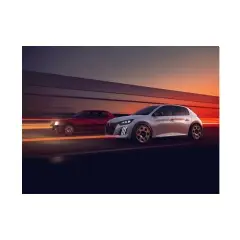
Peugeot’s GTi story now stretches from the 105 hp 205 GTI to the 281 hp E-208 GTi, linking a lightweight hot hatch era to an electric performance model. The new book The Saga of Peugeot GTi sets out to tell that story across more than four decades, pairing the cars’ technical evolution with the memories and people behind the badge.
The E-208 GTi gave the book a timely focal point at the 2026 Paris Motor Show. Peugeot featured the car at its stand and held a dedicated GTi day on October 17. The E-T16 Concept was also shown there, drawing on the competition-bred 205 Turbo 16. Together, the two modern concepts connect the current 2-series to a history shaped by road cars and motorsport.
One badge, several generations
The GTi name has appeared on the 205, 309, 308, 208 and now the E-208. Peugeot’s compact performance identity has also extended beyond cars wearing those three letters. Depending on the model, era and market, the 106, 306, 206 and 207 carried badges including RC, S16, GT or GTi.
That variety matters to the story: the badge alone doesn’t account for every Peugeot that enthusiasts associate with small, quick cars. The book covers the different names alongside the models themselves, following how Peugeot presented its sporty compact cars across generations. It also considers both their road-going versions and their competition counterparts, where the connection between production cars and racing machinery is part of the appeal.
The 205 GTI is an obvious starting point. Its 105 hp provides a clear reference for how much the figures have changed by the time of the 281 hp E-208 GTi. But the comparison is more than a power tally. The cars belong to different mechanical eras, and the arrival of an electric GTi brings a new drivetrain into a name long associated with compact performance. The stated aim across that change, Peugeot says, remains driving pleasure.
Road cars, competition and the Turbo 16
The 205 Turbo 16 occupies a distinct place in the book’s account. It was a competition-bred machine, and its influence reaches into the E-T16 Concept presented alongside the E-208 GTi at the Paris show. That link gives the history a useful through line: Peugeot’s performance image draws from both everyday compact cars and machines developed for competition.
For enthusiasts, the interest lies in how those strands meet. A road-going GTi has to work as a usable car as well as deliver sharp responses; a competition car is built around a different set of demands. Putting both in the same history helps show why the GTi story isn’t simply a list of badges or horsepower figures. The model names, market variations and competition connections give each generation its own context.
The volume is described as richly illustrated, with historical documents and exclusive testimony from people involved in the GTi story. That mix should give readers more than a sequence of model summaries: archive material can place the cars in their period, while firsthand accounts add the perspective of those who helped shape the range. The book contains 132 pages and 132 pictures.
A legacy carried into the E-208
Peugeot CEO Alain Favey writes the editorial, describing the GTi heritage as a source of responsibility and excitement for the company. He frames the E-208 GTi as a new interpretation of the badge and points to the 2-series as a central part of Peugeot’s identity since the 205. That emphasis puts the new electric car in a lineage rather than treating it as a standalone nameplate.
Julien Fébreau, a Formula 1 commentator for Canal+ in France and a member of what he calls the “GTi generation,” wrote the preface. His focus is on the memories and emotion tied to the badge, beyond technical specifications or outright performance. That perspective fits a book spanning several decades: enthusiasts often remember a car through its feel and the experiences attached to it as much as through its figures.
The Saga of Peugeot GTi is available in English and French through the Peugeot Lifestyle shop for €35. For readers following the E-208 GTi, the book offers a way to place the new car alongside the 205, the Turbo 16 and the less obvious RC, S16 and GT chapters. Its clearest point is that Peugeot’s compact performance story has changed shape repeatedly, while the badge still rests on the promise of an engaging drive.


