Ford Le Mans Hypercar Completes First 30-Hour Endurance Test in Barcelona
Ford’s unnamed Le Mans prototype has completed a 30-hour Barcelona test, adding a major endurance run to its European and US development programme.
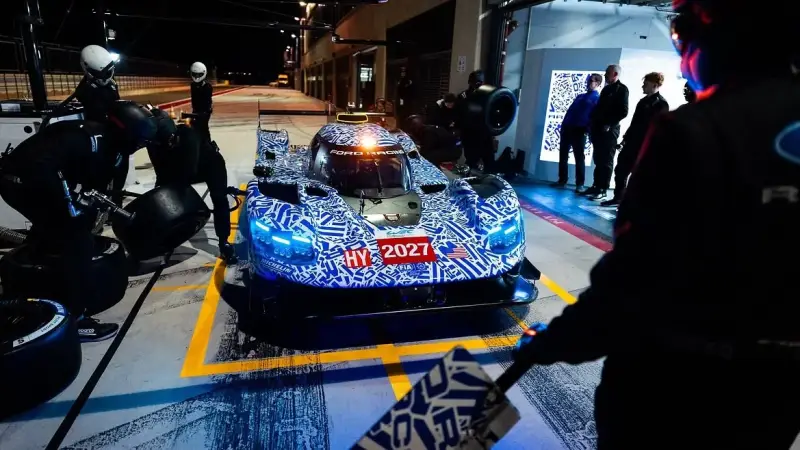
A 30-hour run in Barcelona gives Ford’s Le Mans Hypercar programme a substantial endurance milestone: the prototype has now completed its first test of that length as development continues ahead of its planned 2027 competition debut. CEO Jim Farley shared the update on social media. The car’s name and full technical specification remain under wraps, but its known powertrain ingredients point to a naturally aspirated V8 paired with a hybrid system.
A long test, with more still to learn
Endurance running asks more of a prototype than a short burst of speed. Over an extended session, teams can observe how the car and its systems behave as running accumulates, identify issues that need attention, and build experience with the package. The 30-hour figure marks the length of Ford’s first test at that duration; the available details don’t specify the distance covered, lap times, interruptions, or what components were changed during the run.
That distinction matters. A long test is a development checkpoint, not a race result, and the time alone doesn’t reveal the car’s pace or reliability across every condition it may encounter. What it does show is that Ford has moved beyond shorter circuit sessions and put the prototype through a sustained programme. The next useful details will be how the team describes the car’s progress, and what changes emerge as it works towards its first competitive outing.
Barcelona is the latest location in a testing schedule that has already included a varied set of circuits. In Europe, the prototype has run at Monza, Imola, and MotorLand Aragón. In the United States, it has been tested at Sebring and the Circuit of The Americas. Those venues give the development programme a spread of track environments, although no specific setup choices or test results from those visits have been disclosed.
Known hardware: Coyote-family V8 and hybrid assistance
Ford has yet to reveal the car’s name, but several key components have been identified. Its chassis was developed by ORECA, while the combustion engine is a naturally aspirated V8 based on Ford’s Coyote engine family. The reported displacement is 5.4 litres, and the engine is expected to be heavily modified. It could reach around 9,000 rpm, though that figure remains an expectation rather than a confirmed specification.

The engine is paired with a Bosch electric motor and an Xtrac gearbox as part of the hybrid system. That combination makes the way the components work together a central part of the car’s development story. A high-revving naturally aspirated V8 brings a different character from a turbocharged engine, while the electric motor adds another element to the powertrain’s operation. The source details don’t give output figures, torque, battery capacity, or the precise division of work between the combustion engine and electric motor, so those details remain open.
For now, the hardware list is enough to sketch the broad mechanical direction without pretending the package is fully understood. The Coyote connection gives the V8 a recognisable family lineage, but the expected heavy modification means this shouldn’t be treated as a production engine carried over unchanged. Likewise, the Bosch motor and Xtrac gearbox identify major suppliers, but say little by themselves about calibration, ratios, or how Ford will manage the hybrid system over a long race distance.
Reveal date and first race target
Ford is set to show the Le Mans Hypercar on November 26, which falls on Thanksgiving Day in the United States. The car is scheduled to make its competitive debut at the opening round of the 2027 FIA World Endurance Championship in Qatar in March. That leaves the programme with a clear sequence: continue circuit development, present the finished car, then prepare for its first race appearance.
The Barcelona test is a meaningful step along that path, especially because sustained running can expose questions that brief sessions may not answer. Still, the public information is limited to the test’s duration and location, the circuits visited, and the broad outline of the chassis and powertrain. No lap times, horsepower figures, race simulations, or test findings have been provided.
My read is that the most interesting part to watch is how Ford turns those known components into a complete endurance package. The 5.4-litre V8, Bosch electric motor, Xtrac gearbox, and ORECA-developed chassis are the starting points; the car’s name, detailed specifications, and on-track performance remain to come. The 30-hour run shows the work is advancing, while the November reveal should put a clearer shape around the machine Ford intends to take racing in 2027.