PMW Expo 2026: Additive Manufacturing, Battery Engineering and Motorsport Technology
PMW Expo 2026 put manufacturing and powertrain challenges alongside new products, award winning engineering and specialist performance hardware.
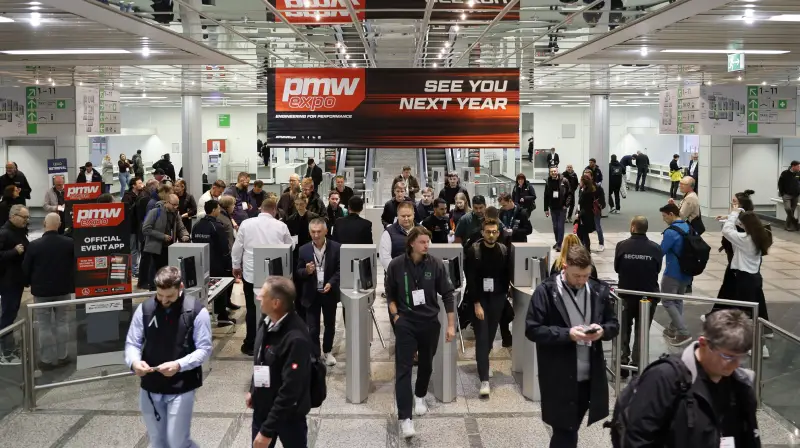
PMW Expo 2026 brought motorsport, high-performance automotive and specialist vehicle manufacturing under one roof for two days of technical talks, product launches and supplier conversations. The strongest thread was practical engineering: how to scale metal additive manufacturing, manage demanding battery systems and carry road-car thinking into competition hardware.
Motion Applied was headline sponsor. The company supplies control and interface units, sensors, software and electrification technology, designed and built in-house, to leading racing series. The show also drew direct support from teams and manufacturers. Simone Genovali, deputy assembly manager at Visa Cash App Racing Bulls, called the event professional and said the team had met many suppliers and planned to return. Cosworth Electronics managing director Paul Newby described PMW as a key date for the company, adding that it uses the expo to launch products.
Engineering people and production
The new Performance Management in Motorsport Forum opened with a session from General Motors F1 performance engineering lead Mandar Hazare on the psychology and science of high-performance culture. His point was that engineering performance depends partly on the conditions people work in: organizational habits shape individual behavior and can either support or constrain innovation. Teams need tactical execution, but they also need room to adapt.

Hazare argued that purpose, belonging and personal growth help people reach their potential, while ownership and development opportunities can sustain a high-performance culture. “Humans are not naturally inclined to flourish,” he said, describing flourishing as the development of a person’s potential, talents and interests. It’s a useful reminder that technical capacity is only part of the equation; the people doing the work need an environment that lets them use it.
Metal additive manufacturing was another focus. Giulio Del Fré, Bosch senior sales manager for power solutions and additive manufacturing services, laid out the barriers to industrial use: production cost, material consistency, internal defects and component durability. “Metal additive manufacturing is changing the engineering equation,” he said.
Del Fré used Bosch’s Compact Gas Compressor to show how the process can offer design flexibility and consistent quality while keeping production costs in view. The project helped build the company’s confidence in the method. Bosch now offers production machinery compatible with several metals, including aluminum, copper and titanium. The practical test for additive manufacturing is whether a component can move beyond an appealing design study and meet repeatable production and durability demands.
Powertrains, batteries and new products
At the Advanced Powertrain Technology Forum, Davide Bizzarri, head of vehicle motion and energy management at Automobili Lamborghini, discussed the Temerario GT3’s bi-turbo V8. The central engineering shift is from the road-going Temerario’s hybrid layout to a fully combustion-powered racing application. That puts Lamborghini’s naturally aspirated heritage in conversation with modern turbocharged development, while adapting the powertrain to a motorsport brief.
Battery development brought a different set of trade-offs. Tom Rose, commercial engineering manager at McMurtry Automotive, used the Spéirling to discuss thermal management, cell joining, safety and certification in high-performance EV battery packs. McMurtry Technology was established with an investment of more than £2 million (US$2.6 million) to support in-house battery development and low-volume manufacturing. Because those facilities demand substantial expertise and cost, McMurtry is opening its capabilities to other industry users and seeking input as it plans to expand toward HEV battery development. Rose summed up the challenge plainly: “Let’s not avoid the obvious: building an HEV battery is hard, even just as a one-off.”
Cosworth Electronics launched two products at the show. In an interview, Newby also outlined AlperX, an ecosystem of technology providers intended to reduce the engineering burden of integrating systems and give customers more value. Cosworth takes on what Newby called the “integration tax,” then continues to add features through a network of partners.
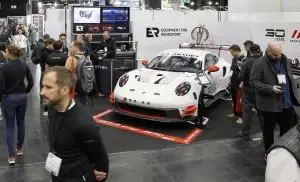
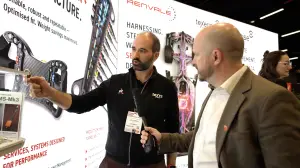
Elsewhere, PWR Europe’s global head of high-performance aftermarket, James Rodgers, described how experience gained in one area can inform work for customers in others: “You can’t unlearn what you learn.” Texys Group sales and marketing manager Thomas Batas-Bjelic showed the company’s sensor range, including the TPMS-Mk3 RS tire-pressure monitoring system. Its recyclable battery can be replaced by users, and the system is being track-tested. An infrared version is planned to follow.
Show-floor hardware and award winners
bf1systems presented tire-pressure and temperature equipment spanning wheel sensors, vehicle electronics and workshop tools. Its 1System platform uses 2.4GHz wireless communications, while the IRTPTMS Pro measures temperature at 28 points across the inner tire carcass. QuickScan provides a portable way to identify sensors and check their condition before fitting wheels. That combination connects race-running data with the pre-event checks that help keep the readings dependable.

Manthey marked its 30th anniversary with two Porsche race-car editions: the 911 GT3 Cup MR 30 and 718 Cayman GT4 RS Clubsport MR 30. The Cup-based car pairs a 4.2-liter six-cylinder boxer engine producing 412kW with revised aerodynamics, cooling and suspension. Its features include carbon-fiber bodywork, a central radiator concept and a newly developed rear wing. The Cayman draws on a decade of development, with lightweight components cutting 5.7kg from the base model’s weight. Production is limited to 15 examples of each car.
RX Carbon showed a rear wing for the Toyota GR Yaris made with flax-fiber prepreg supplied by Bcomp. The company scanned the car in 3D before designing, engineering and manufacturing the wing in-house. Its WRC-inspired styling and aerodynamic profiles target rallycross, rally prototypes, time attack and road-car applications.
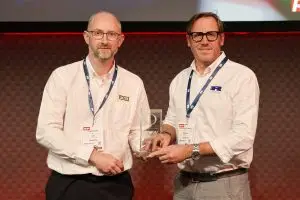
The PMW Awards 2026 recognized work across seven categories, covering areas such as data and electronics, powertrain, chassis, safety and support equipment. A panel of industry experts judged the awards live at the show, with winners announced at a drinks reception sponsored by VP Racing Fuels. JCB and Ricardo claimed two awards for the Hydromax hydrogen combustion engine: Powertrain Technology of the Year and Overall Engineering Innovation of the Year. Motec, bf1systems, Honpe ProtoTec, Aero Tec Laboratories and Fortescue Zero were also among the winners.
JCB chief engineer Chris Ward said the recognition meant a great deal to the team. Ricardo team leader and performance development and technical specialist Richard Cornwell credited the wider crew, including those who spent long hours working on the testbed. The next PMW Expo is scheduled for November 10 and 11, 2027, at Köln Messe in Cologne, Germany, where the show will mark its 20th anniversary.


