Lille-Bror Nasenius and the Opel Rekord B’s 1966 European Rally Title
A near-standard Rekord B helped Lille-Bror Nasenius win the 1966 European production touring car title, launching an 11-win Opel rally career.
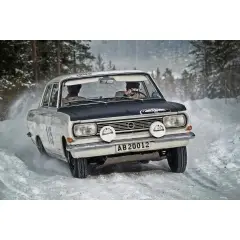
The Opel Rekord B’s 1966 European title came from a straightforward formula: a light, road-going saloon, a strong new engine and a driver who could turn reliability into results. Swedish rally driver Lille-Bror Nasenius won the European Rally Championship for production touring cars in Group 1 that autumn, giving Opel its first major rallying milestone. The World Rally Championship had not yet been established, making the European crown the sport’s highest-level achievement of its kind at the time.
A production Rekord with useful performance
Opel signed Nasenius in January 1966, after he had moved from motorcycles and rallycross to four-wheel competition and begun collecting class and overall wins in regional events. The timing suited both driver and manufacturer. For the 1966 model year, Opel introduced its CIH four-cylinder engine, including a 1.9-litre version rated at 66 kW (90 hp). In the Rekord B, that output worked with a kerb weight of just 990 kilograms to give the car a strong power-to-weight ratio by the standards of its rivals.
Nasenius competed in the Rekord 1900 S, a two-door saloon that remained close to standard specification. The competition car differed from an everyday Rekord B chiefly in its tyres and shock absorbers, according to Opel. That modest preparation made the title especially telling: the car had to carry its driver across rough rally stages while retaining the practical character of a family saloon.
For Nasenius, that dual purpose mattered. He was a father of two, and the Rekord served as both his competition car and family transport. Opel describes it as dependable and safe, qualities that counted alongside speed over a season of varied events. He won the Swedish Rally Championship as well as the European production touring car title in 1966.
From the Rekord C to the Rallye Kadett
Nasenius moved to the Rekord C for 1967, retaining the same engine. The newer car weighed 1,025 kilograms despite its larger dimensions. Its precisely guided coil-spring rear axle made it more manoeuvrable, a useful change when quick direction changes and control over uneven surfaces could shape a rally result. He also entered several races in the Opel Commodore A, the six-cylinder counterpart to the Rekord C.
That season brought Nasenius second place in the European standings, narrowly missing another title. In 1968 he switched to the lighter, more agile Rallye Kadett 1900 S and immediately scored four overall victories. A year later, Björn Cederberg joined him as co-driver. Their partnership carried Nasenius to Swedish Rally Championship wins in 1969, 1970 and 1971.
For 1972 and 1973, he drove the Ascona, then a popular rally choice. Walter Röhrl, one of his direct rivals in that period, later remembered Nasenius as “incredibly helpful” and described their relationship as collegial and almost friendly despite the competition. The recollection adds a human detail to a career built on sustained results across several Opel models.
An 11-win career, with a later return
Nasenius returned to rallying for the 1977 season in a Kadett C 1200 S. He contested seven championship rounds and finished first in his class twice. That marked the end of his official rally career, which produced 11 overall victories and 35 class wins. Opel credits him with nine overall victories and 31 class wins achieved in its cars.
The sequence of machinery shows how different approaches could serve the same driver. The Rekord B brought power and everyday usability in a nearly standard package. The Rekord C added a more manoeuvrable rear suspension layout, while the lighter Rallye Kadett put agility first. The Ascona then carried Nasenius through his final seasons under contract. His results helped establish Opel as a serious rally manufacturer decades before Walter Röhrl and Christian Geistdörfer won the 1982 World Rally Championship in an Ascona 400.
Opel’s electric rally chapter
Opel now points to the ADAC Opel GSE Rally Cup and its Mokka GSE Rally competition car as the next phase of that motorsport history. The Mokka produces up to 207 kW (281 hp) and 345 Newton metres of torque, with the cup series in its sixth year. Opel says the format uses charging infrastructure designed for electric rally competition and runs with locally emissions-free operation.
The technology has changed substantially since Nasenius raced a 90 hp Rekord, but the old car’s appeal still reads clearly: manageable weight, useful power and a setup suited to repeated competition. The 1966 title was built on a production saloon that could do more than one job. That balance between rally pace and practical engineering remains a useful lens for judging Opel’s latest competition cars.


