Nissan Patrol at 75: From 4W60 Trailblazer to Twin-Turbo V6
From Mount Fuji and the Simpson Desert to today’s 425-hp Patrol, seven generations have carried Nissan’s 4x4 nameplate around the world.
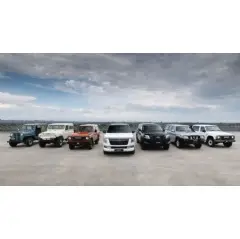
The Nissan Patrol’s 75-year story is built on a useful combination: hard-working four-wheel-drive engineering that kept finding room for more comfort, more technology and more kinds of owners. Nissan’s first 4x4, the 4W60, arrived in Japan in 1951. The seventh-generation Patrol now pairs all-terrain capability with a spacious, premium cabin and a 3.5-liter twin-turbo V6 rated at 425 horsepower and 700 Nm of torque.
For the 2026 anniversary, Nissan is marking that history with two distinct moves. In the U.S., the 2027 Armada gains a Patrol PRO-4X trim, bringing Patrol badging back to the market for the first time since 1969. In the Middle East, Nissan is preparing a limited 75th Anniversary Patrol: a Platinum V6TT with Copper Gold exterior accents, a Bordeaux interior and dedicated regional details. The initial run is set at 1,951 units, a nod to the nameplate’s debut year.
Nissan CEO van Espinosa described Patrol as part of the company’s history and “the heartbeat of our brand,” connecting its engineering and adventure heritage with the next generation of customers. That continuity runs through seven generations, even as the Patrol’s role and market names have shifted.
From Japan’s first Nissan 4x4 to an international name
The first-generation 4W60 launched in 1951 and climbed Mount Fuji that same year. Its arrival in Kuwait in 1957 began a long relationship with the Middle East, where the Patrol would become especially significant. The 60 Series, introduced in 1960, took the model further afield: its first major shipment went to Colombia, with Australia and the U.S. following in 1961.
Australia supplied one of the Patrol’s defining tests. The 60 Series became the first motorized vehicle to cross the Simpson Desert, covering more than 1,100 sand dunes between the Northern Territory and Queensland in 12 days. It’s a milestone that makes the Patrol’s reputation tangible: the achievement depended on a vehicle that could keep moving across demanding terrain for days, not just look the part.
More room for families, and a place in competition
The 160 Series arrived in 1980 with five-door and seven-seat configurations, broadening the Patrol’s appeal beyond utility work while retaining four-wheel drive. Nissan also offered pickup and long-wheelbase wagon versions in South Africa. In 1983, the model became the first Nissan manufactured in Europe, at the company’s Barcelona plant.
That year also began a notable Australian competition run. The Patrol 160 gained its first turbo-diesel engine and went on to win the unmodified division of the Australian Off-Road Championship for 15 consecutive years, starting in 1983. That record gives the diesel model a practical place in the Patrol story: it wasn’t only a long-distance workhorse, but a platform that could prove its durability in sustained off-road competition.
Launched in 1987, the Y60 brought coil-spring suspension, power steering and improved comfort. The same year, the “Fanta Limon” Patrol 160 finished in the Paris-Dakar Rally’s overall top 10, becoming the first diesel-powered vehicle to reach that position. The Y60’s suspension change marked a different kind of progress: the Patrol’s capability remained central, while its road manners and comfort also moved forward.
New equipment, long journeys and record-setting stunts
The Y61 debuted in 1997 with a smoother body, updated interior and equipment that included satellite navigation and a reverse camera. In 2007, two Y61 Patrols completed the 15,000-mile “Long Way Down” expedition from John O’Groats in the U.K. to Cape Town, South Africa, with one puncture between them.
The Y62, launched in 2010, pushed further into comfort and technology. Its later feats ranged from outright pulling power to carefully staged spectacle: in 2013, it towed a 170.9-metric-ton aircraft for 50 meters; in 2015, it recorded the fastest ascent of a 100-meter sand dune by a production vehicle; and in 2018, 180 Patrols took part in the world’s largest synchronized car dance. Nissan says the Y62 set three Guinness World Records through these achievements.
In 2015, the Patrol became the first Nissan model in the Middle East to receive a NISMO version. A year later, the Patrol returned to the U.S. as the 2017 Armada, based on the Y62 and powered by a 390-horsepower, 5.6-liter V8.
The seventh generation and the anniversary editions
Nissan unveiled the seventh-generation Patrol in Abu Dhabi in 2024. Its 3.5-liter twin-turbo V6 produces 425 horsepower and 700 Nm of torque, while the cabin adds space, premium appointments and newer technology. Production of the latest Patrol and U.S. Armada began in 2025 at Nissan Shatai Kyushu in Japan.
Nissan says more than two million Patrol-family vehicles have been sold worldwide. The Patrol is currently available in 42 markets, including the U.S., UAE, Saudi Arabia, the Philippines and Australia; in Japan it has also been known as the Safari, while the Patrol-based U.S. model is called Armada. Nissan says the model is due to reach additional markets.
The anniversary editions give that history two different expressions: the U.S. Armada Patrol PRO-4X connects the name to a familiar market, while the Middle East Platinum V6TT celebrates the region with dedicated colors and trim. The details to watch are how the Patrol badge and its established off-road character carry into those versions—and how the latest generation balances that heritage with its more powerful, more spacious package.


