Rolls-Royce Backgammon Set Pairs Bespoke Materials With Mechanical Detail
A year of development went into a playable backgammon set with a counter-rotating hinge, walnut marquetry and leather details inspired by ancient Mesopotamia.
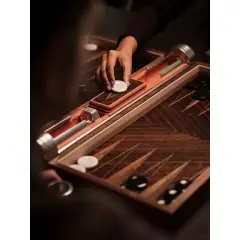
Rolls-Royce’s Backgammon Set treats a familiar pastime as a piece of mechanical design. Developed by the marque’s Bespoke Collective at Goodwood, it combines a playable board with carefully worked materials and an opening mechanism that turns setting up a game into part of the experience. The design draws on backgammon’s ancient roots and on a Rolls-Royce connection that reaches back to a 1938 Wraith fitted with a board in its rear passenger compartment.
The set took more than a year to develop, from research through prototyping. The team played the game during that process, using its movement and pace to guide practical decisions: how the counters feel in the hand, how smoothly they travel over the board, and where each component belongs. That attention matters here. A display piece can be judged from across a room; a playable one also has to feel considered in use.
A hinge that stages the game
The opening sequence centres on a proprietary hinge machined from a solid billet of aluminium. It is hand-polished before anodising, and it does more than join the two halves of the case. As the hinge rotates, the central spine counter-rotates to expose the board and playing pieces. A Spirit of Ecstasy mounted to the hinge stays upright regardless of the board’s final position, echoing the self-levelling wheel centre-caps used on Rolls-Royce motor cars.
The storage layout keeps the playing surface clear while giving each accessory a defined place. Counters sit inside the central spine. Precision dice, the doubling die and two dice shakers are arranged around a removable plinth. That plinth doubles as the bar used to hold captured counters during play, so a piece that serves as part of the set’s presentation also has a job at the table.
The board is made from solid American walnut, selected to support the weight of the aluminium hinge. Its veneer is book-matched at 55 degrees, an angle that references veneer application in Rolls-Royce interiors. Each sheet is chosen to meet the marque’s specifications, with a smooth finish intended to let the counters glide across the surface.
Walnut, eucalyptus and desert tones
Marquetry forms the home and outer boards. Each point is assembled from open-pore Royal Walnut and Smoked Eucalyptus veneers that are precision-cut and individually set. The pattern has to work at two scales: it needs to read as a composed surface when the board is displayed, while remaining clear as the game moves from one side to the other.
Sunset and Sunrise natural grain leather trim the set. Rolls-Royce chose the warm tones to reference the landscapes of ancient Mesopotamia, where the game’s origins can be traced to more than 5,000 years ago. Archaeological discoveries in the 1920s brought some of the earliest known playing boards to light. The palette gives that history a material expression without turning the board into a replica of an ancient object.
The exterior carries a Placed Perforation motif inspired by dunes seen from above. It is a Bespoke treatment familiar to clients who have commissioned the feature for their cars, bringing a specific piece of Rolls-Royce interior design language onto an object intended for the home.
Playing pieces built for the hand
The stones are machined from a composite infused with bauxite ore and finished in Deep Night Sky black and Antarctica white. Their high-gloss surfaces carry a fine fleck that catches the light as they move. Rolls-Royce describes their feel as smooth and weighted, closer to river stones than conventional playing pieces. For a game in which counters are handled constantly, that tactile quality is central to the design rather than an incidental finish.
The doubling die departs from the usual cube shape. It is a hexagon, a form that references natural honeycomb structures as well as the geometry of a nut and bolt. Those cues also connect with the Rolls-Royce Apiaries at Goodwood and in Munich, Dubai, Abu Dhabi, Manama and Doha. Machined from anodised aluminium, the die has polished numerals and sits in the board’s counter well when it isn’t in use.
The aluminium dice shakers are finished to match the hinge. Leather on their bases softens the sound of a throw, and a Spirit of Ecstasy is engraved underneath each one. These details show the set’s approach in miniature: surfaces and components are shaped for both appearance and handling, with a mechanical reference carried through to objects used during play.
A board to play and display
Backgammon has remained a pastime among Rolls-Royce clients since the 1938 Wraith installation, and the new set carries that thread into a standalone object. Its walnut structure, working hinge and organised storage make the piece more than a board placed on a table, while its marquetry and leather finish give it a presence suited to permanent display at home.
The Rolls-Royce Backgammon Set is available for commission through Rolls-Royce showrooms and Private Office boutiques. Its appeal rests in the balance: the mechanism has a clear purpose, the materials connect to both the game’s history and the marque’s cars, and the pieces are designed to earn their place at the table once the display gives way to a match.


