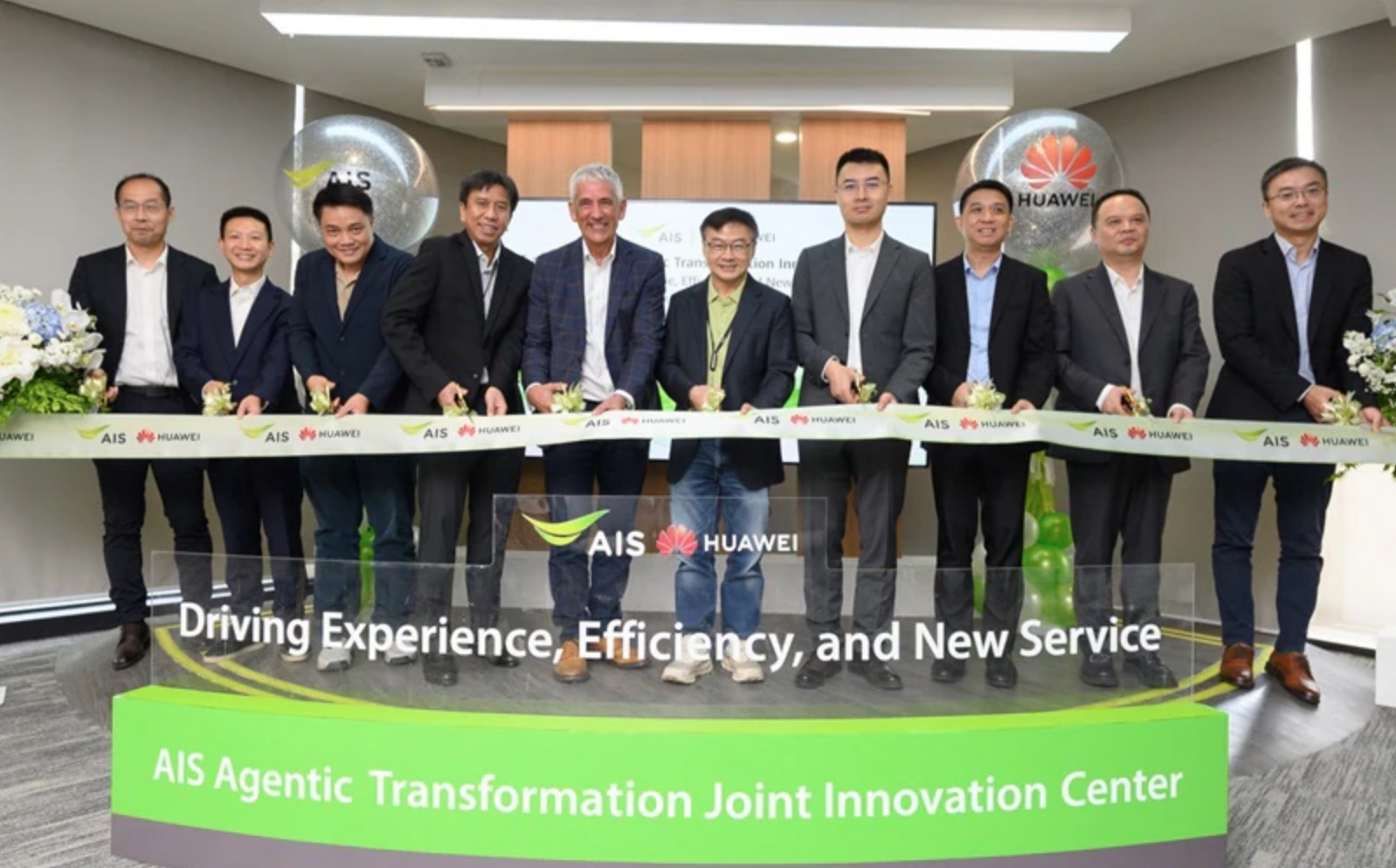
AIS and Huawei Open Thailand’s First Autonomous Networks Innovation Center
AIS and Huawei’s Thailand center showcases Level 4 network autonomy, with reported gains in fault diagnosis, field operations, customer experience and energy use.
AIS and Huawei have opened a joint innovation center in Thailand to demonstrate autonomous network technology on live networks. It’s the first Autonomous Networks (AN) innovation center outside China, and its focus is a practical one: showing how automation can move beyond isolated tasks toward coordinated operations across several telecom network domains.
The center builds on strategic collaboration that began in 2022. AIS has made AN a core part of its intelligent infrastructure transformation and set an evolution roadmap for the work. The new facility brings together examples from maintenance, optimization and operations, giving industry participants a place to examine systems in use and exchange experience around their deployment.
From individual tasks to coordinated autonomy
The work spans wireless, datacom, optical and core networks. Across those areas, Huawei and AIS describe practices involving both single-domain agents and agents that coordinate across domains. That distinction matters: automating a task inside one network area can improve a specific workflow, while cross-domain coordination can help teams manage situations that touch several parts of the network.
The launch also marks a shift in the project’s stated development path. Its first phase centered on autonomy in individual scenarios; the second moves toward collaboration across multiple scenarios. Huawei and AIS say the center includes the first IP and core network single-domain autonomy solution outside China, alongside a cross-domain agent collaboration solution and RANSpirit. The stated aim is to connect these capabilities into broader network operations rather than treat each automated function as a standalone tool.
For telecom operators, this kind of progression depends on how well systems can interpret operating goals, diagnose conditions and coordinate responses. Single-domain autonomy addresses decisions within one network area. Cross-domain systems add the task of aligning those decisions when a service issue or operational change spans multiple areas. The center’s demonstrations are intended to show how those pieces work in practice.
Reported operating results
The figures shared for the center cover operational efficiency, customer experience, network resilience and energy use. Huawei and AIS report that the cloud core agent achieves a 90% automated diagnosis rate. In IP operations, single-domain autonomy is reported to raise field operations and maintenance efficiency by 15%.
On the customer side, the automated complaint diagnosis rate reaches 70%, while customer complaints are down 10% year on year. Those measures connect network operations to a result that subscribers can feel: quicker identification of possible causes can help teams direct investigations and respond to recurring service problems. The figures are reported outcomes associated with the work, rather than a guarantee that every network will see the same results.
For resilience, Huawei and AIS point to CORESpirit, which enables hierarchical fault autonomy and service recovery on a minute-level timescale. The description emphasizes a structured response to faults, with recovery actions handled at different levels. That approach is intended to reduce the time between detecting a network problem and restoring service.
Energy consumption across the network is reported to have fallen by more than 3%. Energy performance is a useful measure alongside fault handling and service quality because automated network decisions can affect how resources are managed during changing demand. The stated result gives the center another operating measure to track as the work expands.
A platform for industry exchange
AIS and Huawei say the center will support demonstrations on live networks and provide a forum for industry participants to compare experience. Its role is to make Level 4 capabilities visible in operating conditions and offer other operators a reference path for their own autonomy programs. The partners also plan to continue developing end-to-end network autonomy solutions and to support open collaboration through the OpenAN open-source project.
TM Forum’s Autonomous Network Levels provide a maturity model that operators can use to assess and plan automation. The scale runs from Level 0, where operations are fully manual, to Level 5, described as full autonomy. Level 4 represents a highly autonomous network built around intent-driven operations, predictive analytics and AI-based closed-loop management.
That framework helps explain why the center’s emphasis on several scenarios and network domains matters. Level 4 work calls for more than automating a single repeatable action; it involves linking analysis and operational responses across a wider set of conditions. The demonstrations in Thailand give operators and industry participants a chance to see how those capabilities are being assembled and assessed.
The launch ceremony was attended by Ken Lu, President of Huawei’s General Development Department; Wasit Wattanasap, Head of Nationwide Operations and Support Business Unit at AIS; George Glass, CTO of TM Forum; and representatives from other industry participants. Denny Deng, President of Asia Pacific Carrier Business at Huawei, delivered a speech.
For AIS and Huawei, the next test is whether the center’s reported gains and cross-domain demonstrations can support broader deployment across high-value network scenarios. The clearest measure to watch is how effectively the system connects diagnosis, coordinated action and service recovery as the scope expands.
===