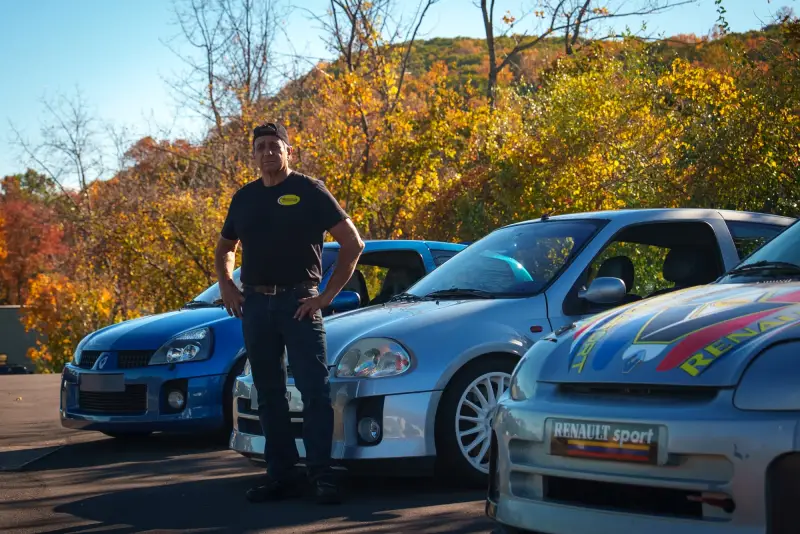
Renault Clio V6: Pete Boccarossa’s Mid-Engined French Pocket Rocket Collection
Three Clio V6s share Pete Boccarossa’s Connecticut shop, from a rebuilt 375-whp Trophy to a road car just reaching 25 years old.
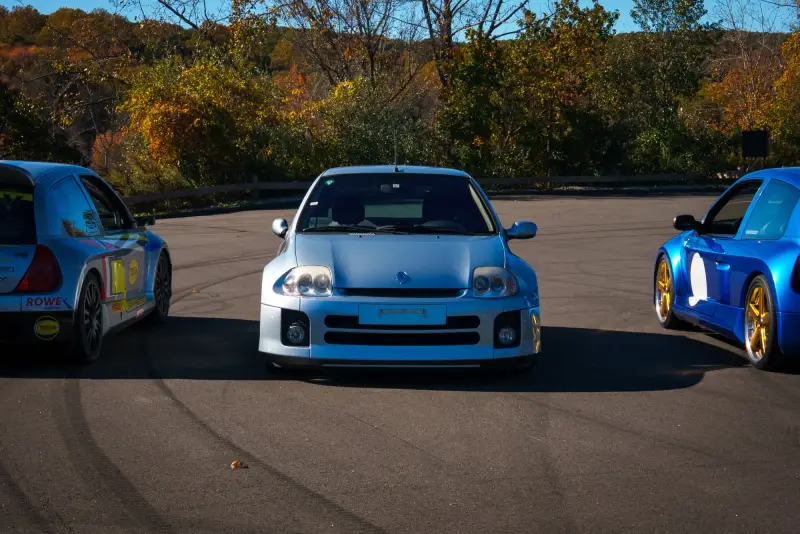
Pete Boccarossa judges a car by the glance he gives it after walking away. If he turns around to look again, it has passed. His Renault Clio V6s pass that test; a new Corvette did not. He admired the Corvette’s ability, but its mix of visual cues never made him want another look. The Clios do, and their appeal rests on a striking mechanical idea as much as their compact, wide-bodied shape: Renault took a small hatchback, put a V6 behind the front seats and sent its power to the rear wheels.
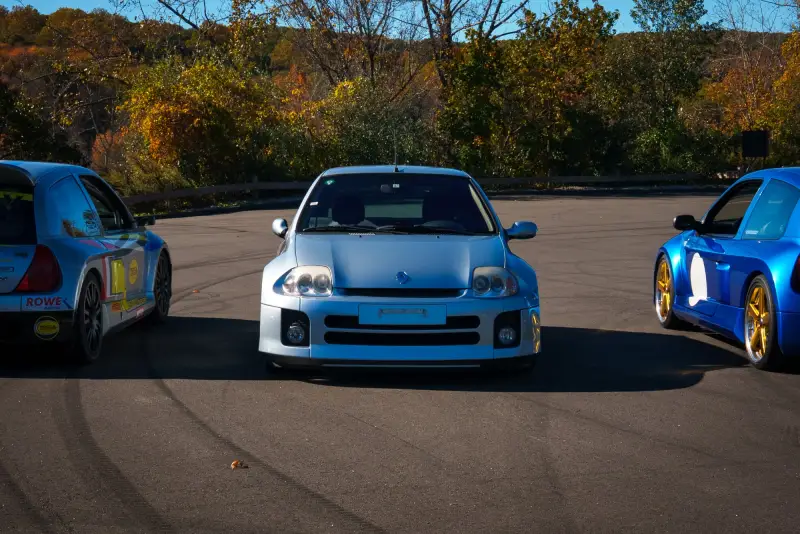
Boccarossa first noticed the Clio V6 Trophy in a video game his children were playing. Looking into the car’s history led him to an older Renault with a similar appetite for unlikely packaging: the Renault 5 Turbo. Renault had installed a turbocharged four-cylinder behind the seats of the R5 in 1980 and taken it rallying. Boccarossa owns a couple of those, too, but says the Clio is better in every respect, comfort included. He describes the R5 as “like a friggin oven on wheels.”
From concept to mid-engined road car
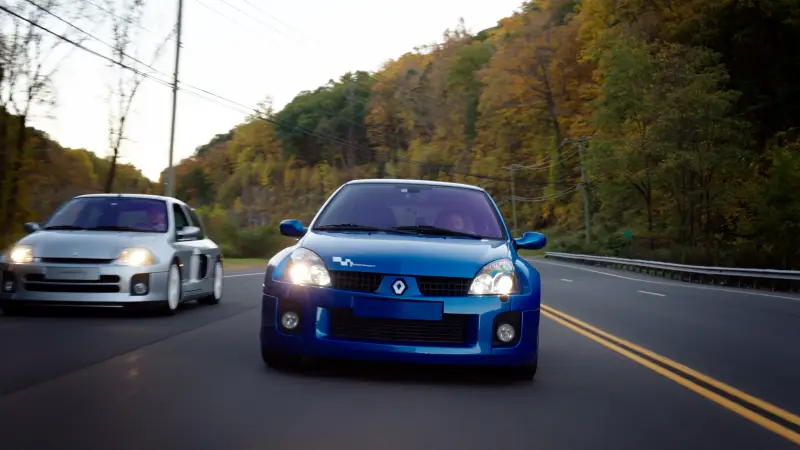
The Clio V6 idea appeared as a concept at the 1998 Paris show. The response was strong enough for Renault to hand development and production of the car to Tom Walkinshaw Racing, or TWR. The conversion changed the Clio’s basic layout: TWR removed the structure and equipment behind the front seats, then fitted a 3.0-liter V6 borrowed from Renault’s Laguna family car. Mounted transversely where the rear seat had been, the engine drove the rear wheels through a six-speed transmission.
“It’s literally just two tires, seat and motor,” Boccarossa says. That description gets at the car’s unusual proportions. Its rear track is much wider than the standard Clio’s, and swollen fenders cover the extra width. The engine sits high and close behind the occupants, while the short wheelbase leaves little distance between the front and rear axles. That combination makes the V6 feel far removed from an ordinary front-drive hatchback, even though the body began with one.
Renault’s competition program came before the road-going version. The one-make Clio V6 Trophy series began at Jarama in 1999, the year Renault marked its centenary. Trophy cars produced 281 horsepower and used a sequential six-speed gearbox. They appeared as a support race at Le Mans that summer, with later stops at Monaco and the Nürburgring. Boccarossa recalls experienced drivers among the field, including Anthony Beltoise and Philippe Siffert, both sons of Formula One drivers, and Bernd Mayländer, who later became the Formula One safety car driver. Many other owners were gentleman racers, and crashes took a number of cars out of action.
Road-car handling and the Phase 2 changes
When road cars followed in 2001, the layout brought a particular handling challenge. Weight transfer could make the Clio V6 feel composed until the car reached the point where its rear end wanted to come around. TWR’s setup included substantial understeer to help keep the back of the car in line. That tuning mattered: with a V6 behind the cabin, a short wheelbase and rear-wheel drive, the car’s balance could demand a quick response from its driver.
TWR folded in 2002, and Renault Sport took over the project at the Alpine works in Dieppe. The later Phase 2 received a longer wheelbase and a stiffer rear end. Boccarossa says the revised car avoids the earlier model’s sudden, unsettling edge. The changes addressed how the car behaved when weight shifted under cornering, shaping the Clio into a more predictable road car while preserving the unusual mid-engine layout.
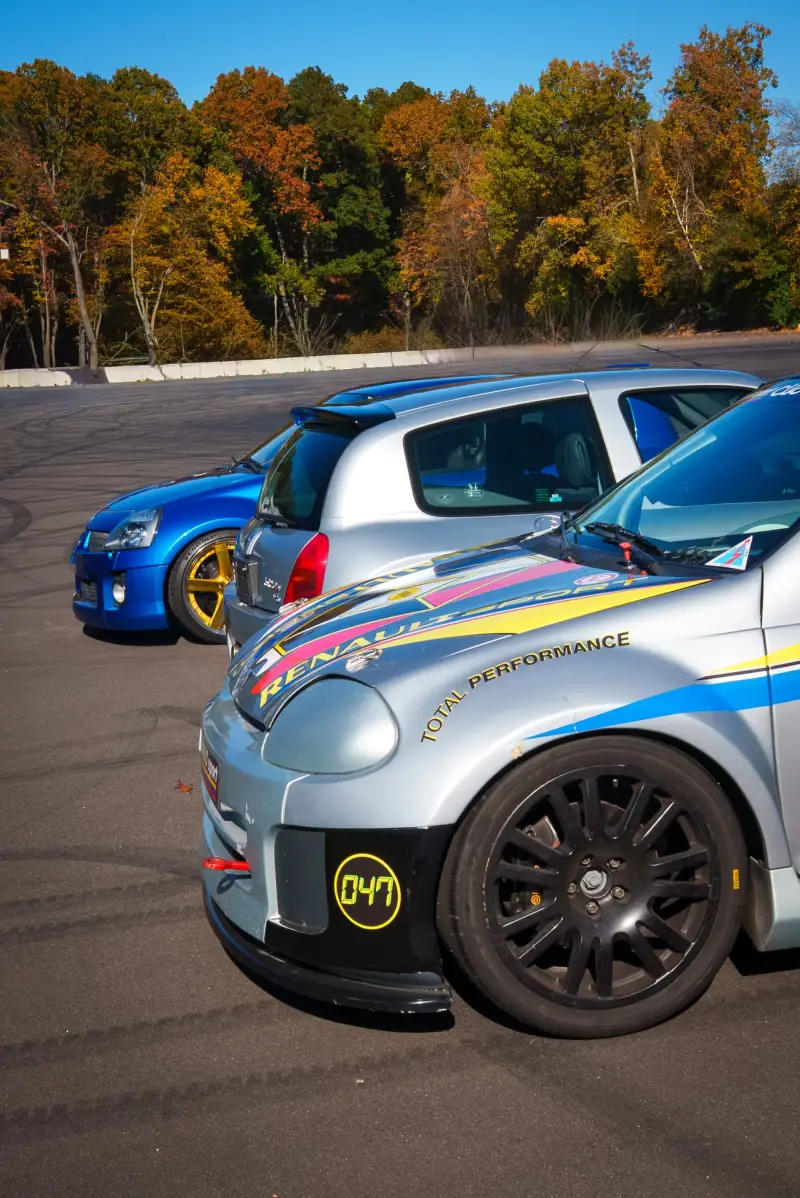
Three Clios at Bocca Motors
Boccarossa now has three Clio V6s at Bocca Motors in Bethel, Connecticut. He estimates there may be ten in the country. His first was a Phase 2 found through a Japanese auction site, with 4,000 kilometers showing. Delivered with everything included, it cost about $35,000. A second car arrived from Italy a couple of months later. “I figured you can’t just have one,” he says.
The third is a Trophy that was already in the United States and had been used for racing. Its engine failed on the day it arrived. The shop rebuilt it from top to bottom, and Boccarossa says it now makes 375 horsepower at the wheels. That figure belongs to this rebuilt Trophy, not the standard Trophy specification of 281 horsepower. One of the road cars, a 2001 model, has just turned 25 and is finally getting plates.
The cars became a bigger part of Boccarossa’s life after a serious motorcycle crash. On Father’s Day about ten years ago, a car turned left across his path as he rode home from breakfast. The collision broke 28 bones; he says he died twice, including once in the medevac helicopter. At the time, he had owned 175 motorcycles, with 75 packed into his home garage. Recovering on crutches, he had to climb over ten of them to reach the bathroom.
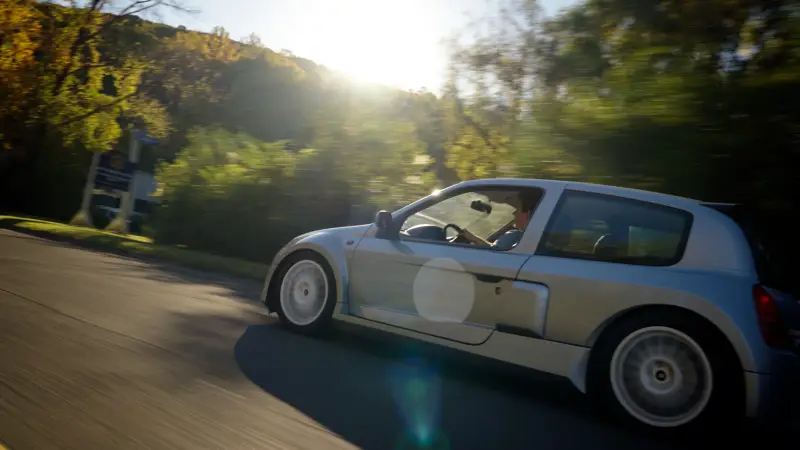
He decided he had enough. He sent 50 motorcycles to Mecum, donated many others to museums, including Barber, and kept about 20 he truly loved. Some of the bikes he sold had never been ridden. After that, he started putting more miles on his cars, rotating through them between home and the shop four miles away. He says he often drives four different cars in a day.
At the shop, Boccarossa fits slicks to the Clios and runs laps around the parking lot he calls the Bocca Motors Proving Ground. “It’s almost like playing go karts, but you get to sit down in a real car,” he says. That use makes sense for a machine conceived around compact dimensions and a rear-mounted engine: short laps let him enjoy its agility without needing a circuit to make the car feel special.
Boccarossa recalls that a Clio V6 could be found for $50,000 to $60,000 a few years ago, and puts today’s range at $80,000 to $120,000. His interest, though, comes back to driving. He can choose a different car for the gym, take the Clio out on the backroads at sunset and let the engine climb to 7,000 rpm. For a car that began as an unlikely mid-engine experiment, that combination of rarity, mechanical character and regular use is exactly why he still turns around to look.