Maserati Track Assist Brings a Digital Driving Coach to the GT2 Stradale
Maserati’s track coaching system manages braking and acceleration to help drivers refine their technique, with Master Maserati sessions set to add it in 2027.
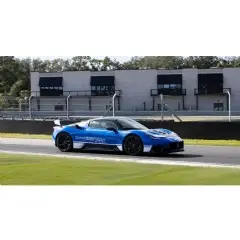
Maserati’s new Track Assist project is designed to make each circuit lap a learning opportunity. Developed with Italian startup AS.CAR.I, the system is being integrated and validated on the Maserati GT2 Stradale. Its aim is to help drivers work on braking points, corner speed and precision while keeping them in control of the experience.
Maserati Corse presented the technology at the sixth Motorsports Club of Clubs, held October 26–28, 2026, at The Motor Enclave in Tampa, Florida. Demonstrations and hot laps in the GT2 Stradale gave attendees a look at the system in a high-performance car shaped by Maserati’s racing work. Maserati plans to bring Track Assist into its Master Maserati Driving Experience program starting in 2027.
A coach that works through the car
Track Assist is built around Active Performance Control (APC), which is undergoing integration, calibration and validation on the GT2 Stradale. The system works with the car’s integrated braking system and manages braking and acceleration to support the driver at key points around a circuit. It is intended to help identify suitable braking points, reduce errors and maintain appropriate speed at the apex.
That makes the project different in purpose from a conventional driver aid. Maserati describes it as a digital trainer: its job is to help drivers develop their own technique, rather than take over the task of driving. Better awareness of how the car behaves can help a driver build confidence and improve precision lap by lap, while retaining the physical, hands-on feel that makes track driving rewarding.
For a learning tool to be useful, its guidance has to relate to the circuit and the car’s behavior. Braking too early or too late affects how much speed a driver carries into a corner; arriving at the apex at the right pace matters for control and for setting up the next section. Track Assist is intended to address those parts of a lap through active support, giving drivers clearer feedback as they practice. Maserati says the system is designed specifically for circuit use.
Engineering collaboration with AS.CAR.I
AS.CAR.I was founded in 2023 and grew out of the mOve research group and the PoliMOVE team at Politecnico di Milano. The company has developed expertise in autonomous driving and motorsport technology. Its proprietary software, algorithms and core technology underpin Track Assist; Maserati’s work focuses on adapting the application to its vehicles and completing the integration, calibration and validation for the brand’s requirements.
That division of work matters because a driver coaching system has to function as part of the vehicle, not as an isolated piece of software. Braking and acceleration support need to suit the car’s controls and the demands of track driving. Testing on the GT2 Stradale is therefore a key step between AS.CAR.I’s underlying technology and its intended use in Maserati’s customer driving program.
From Tampa demonstrations to driver training
Motorsports Club of Clubs, organized by Tilke, brings together private circuit owners and operators and motorsport clubs. The international network was founded in 2019 and counts around 40 organizations. For Maserati, the Tampa gathering offered a chance to show Track Assist to people connected to circuit operations and high-performance driving experiences.
The planned 2027 introduction will pair the technology with professional instructors at Master Maserati Driving Experience sessions. The program offers on-track activities tailored to different skill levels, with participants driving Maserati vehicles in a controlled setting. Adding Track Assist could give instructors and drivers another way to focus practice on technique, while keeping coaching and the driver’s own judgment central to the session.
The system is still undergoing vehicle integration and validation, so its future role will depend on that work. Its proposed place in the training program is clear: use real-time support to make time behind the wheel more instructive, then let drivers apply what they learn.
Cars that framed the technology
The GT2 Stradale was the event’s dynamic centerpiece. Developed to bring expertise from the racing Maserati GT2 to a road-legal car, it uses a 3.0-liter Nettuno V6 rated at 640 hp, described by Maserati as the most powerful internal-combustion engine fitted to one of its road-legal cars. Maserati lists 0–100 km/h acceleration at 2.7 seconds and a top speed exceeding 320 km/h. The car is 60 kg lighter than the MC20, a reduction that supports its track-focused character.
Two other models completed the display. The MCXtrema is a 740-hp, track-only car limited to 62 units. The New Grecale represented the brand’s SUV range, pairing a sportier character with cabin space and everyday usability. Together, the cars showed the range of vehicles surrounding Maserati’s motorsport identity, from a road-going super sports car fitted with the new coaching technology to a purpose-built track machine and an everyday SUV.
Track Assist’s next test is the move from development work on the GT2 Stradale to use in driver training. If the system delivers its intended guidance without dulling the driver’s connection to the car, Master Maserati sessions could turn each lap into a more focused exercise in braking, cornering and control.


