Opel Grandland Electric Adds 22-kW AC Charging Across Three Variants
A new 22-kW on-board charger cuts stated AC charging times for the Grandland Electric range, alongside long-distance capability and standard Frequency Selective Damping.
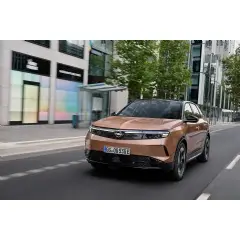
The Opel Grandland Electric’s new 22-kW on-board charger gives the SUV range a useful boost in everyday charging flexibility. It’s available across the Grandland Electric, Long Range and AWD variants, and can make a substantial difference when the car is connected to an AC charger that can supply the higher rate. The hardware won’t make every charging stop faster: the charging point, battery conditions and vehicle settings all affect the result. But where the infrastructure supports it, the higher-capacity charger can cut the time needed to replenish the battery sharply.
Opel describes the Grandland as its first passenger car available with a 22-kW on-board charger. The option covers the standard Electric model, the Long Range version and the dual-motor Electric AWD. All three can also charge at DC fast-charging stations. For owners charging at home, work or a public AC point, the key question is whether the available supply can take advantage of the car’s higher AC charging capability.
Charging times depend on the supply
Opel’s stated comparison shows the potential benefit clearly. For the Grandland Electric and Grandland Electric AWD, both fitted with a 78-kWh battery and 73 kWh of usable capacity, the estimated AC charging time falls from around five hours at 11 kW to just over 2.5 hours at 22 kW. For the Long Range model, which has 96.9 kWh of usable capacity, the stated time drops from 6.5 hours to 3.25 hours.
Those figures describe charging under suitable conditions; they aren’t a promise that every session will take exactly that long. Opel lists several factors that can change the result, including the charging station’s output, outside and battery temperature, the battery’s state of charge and condition, and the car’s equipment and settings. A 22-kW on-board charger is most valuable when the AC charging point and the rest of the charging setup can deliver the power it is built to accept.
That makes the upgrade especially relevant for drivers who regularly leave the car parked for a few hours where a compatible AC supply is available. Shorter charging windows can make it easier to fit a substantial top-up into a workday or an overnight stop. The practical gain depends on the owner’s routine and local charging hardware, so the charger’s headline capacity is only part of the ownership picture.
Range and chassis details
Opel gives the Grandland Electric a WLTP range of up to 519 kilometres, while the Long Range version is rated for up to 691 kilometres. These are test-cycle figures; the company says real-world range varies with driving style, route, temperature, climate control use and battery preconditioning. The figures give a reference for comparing the variants, while actual range will reflect the conditions each driver encounters.
All-electric Grandland variants come standard with Frequency Selective Damping. The system changes its damping response according to the road surface, driving style and the frequency of suspension movement. In Opel’s description, it is set up to absorb short, sharp impacts such as cobblestones while retaining a more direct feel during more spirited driving. That balance matters in a family-sized SUV: suspension compliance can take the edge off rough surfaces, while controlled body movement helps the vehicle feel composed through corners and under braking.
Opel also says the chassis is tuned to remain stable during braking, cornering and higher-speed Autobahn driving. Those are manufacturer claims rather than independent test results, but they outline the intended character: a comfortable ride over broken surfaces with enough control to keep the car settled when the pace rises.
Dual-motor AWD brings four drive modes
The Grandland Electric AWD pairs two electric motors for a combined output of 239 kW, or 325 hp, with torque of up to 509 Newton metres. Its four drive modes are Normal, Eco, Sport and 4WD. In 4WD, both motors run continuously and distribute power evenly to all four wheels, with the stated aim of improving grip on slippery surfaces. Sport sharpens the steering and accelerator response, and peak power and torque are available in both Sport and 4WD.
The AWD model’s extra traction hardware gives it a distinct role in the range, while the selectable modes let the driver tailor the response to conditions. The figures establish the performance potential, but Opel’s description doesn’t include independent acceleration or handling results. For owners weighing the AWD against the single-motor versions, the useful distinction is the addition of a second motor, selectable four-wheel drive and the associated output figures.
Included services and consumption figures
For private customers in Germany buying a fully electric passenger car through participating Opel partners by December 31, 2026, the Electric All In offer includes services such as a Free2Move charging pass, e-routes functions, and eight years of mobile charging and breakdown assistance. Opel states that the assistance lasts for eight years or 160,000 kilometres, whichever comes first. The offer also includes a battery warranty covering at least 70 per cent of the original charge capacity after that period or distance, subject to its warranty terms.
Opel lists combined WLTP energy consumption at 17.8 kWh/100 km for the Grandland Electric, 18.6 kWh/100 km for the Long Range and 18.3 kWh/100 km for the AWD. The company notes that consumption depends on driving behaviour and other conditions. Taken together, the range, charging and chassis details show where each version makes its case: the 22-kW charger can reduce AC charging time when the supply allows it, the Long Range prioritizes distance between stops, and the AWD adds dual-motor traction and higher output. For prospective owners, matching those features to their regular routes and available charging points is the practical next step.


