Tate’s 2026–27 Transnational Programme Connects Art, Memory and Material
From resistance and ink painting to African diasporic performance, Tate’s programme spans exhibitions, research, events and curatorial roles through 2027.
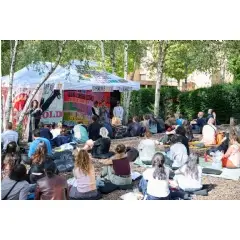
The Hyundai Tate Research Centre: Transnational’s 2026–27 programme puts research into motion across exhibitions, collection displays, performances and events. Its subjects range from artistic resistance and ink painting to education networks, displacement, ecology and the ways communities carry memory. Launched in 2019, the Centre works with people and organisations around the world, with research intended to inform activity across Tate’s four galleries and beyond.
The programme is supported by a long-term relationship between Tate and Hyundai Motor, extended until 2036. The Centre’s work reaches the public through both major exhibitions and free displays, as well as talks, workshops and performances. Here, the connecting idea is that art history takes shape through exchange: between artists and institutions, across regions, and through the methods people use to pass knowledge on.
Resistance, memory and artistic networks
The 2026 Annual Symposium, Transnational Resistances, brings together artists, academics and activists to consider how resistance is practised and embodied through art. The two-day event is a collaboration with IMMA (Irish Museum of Modern Art) and Mathaf: Arab Museum of Modern Art. Participants include Bernadette Devlin, Zeina Maasri, Basel Abbas & Ruanne Abou-Rahme, and Dr Isobel Harbison.
The symposium’s programme extends beyond the talks. Outdoor screenings at IMMA and an online reading group will look at how artists work in relation to resistance movements. The 2027 Annual Symposium is planned around art and spirituality, with talks, performances, workshops and screenings across two days.
Research is also connected to current displays. At Tate Modern, the Ana Mendieta exhibition is open until 17 January 2027. The free display Teach by Example, on view until June 2027, looks at artistic networks and education spaces that developed across Africa in the late twentieth century. Its focus puts shared learning and the institutions around art in view alongside individual practice.
Ink and the image of everyday life
In 2027, Tate Modern will present Ink, its first exhibition dedicated to ink painting, an artistic tradition with a long history. The exhibition brings together seven modern artists from mainland China, Hong Kong and Taiwan. It runs from 22 April to 30 August 2027, and the Centre’s research will underpin the project. For artists working with ink, the medium carries both material and philosophical associations; the accompanying event Ink as Method will take up those philosophies on 24 April.
Ink will coincide with A Year in Art: Lebanon 1990, a free collection display opening at Tate Modern on 12 April 2027. It brings together artists whose work considers how conflict and displacement shape image-making, collective memory and daily life. Placed alongside the exhibition, the display broadens the programme’s attention from a particular medium to the histories and lived experience that images can hold.
Street art, performance and ecology
Several events carry the Centre’s research into performance and public space. Theatre of the Street at Tate Modern on 5 December 2026 explores street and public art. The online event Lessons in Spiral Time, scheduled for 25 November 2026 in collaboration with MASP (São Paulo Museum of Art), examines how African and African diasporic traditions carry knowledge, memory and history through performance, sound and storytelling.
At Tate Britain, Café Alger marks the end of Zineb Sedira’s commission on 17 January 2027. Algerian archivist Nabil Djedouani will present a lecture-performance, followed by a set from Algerian-Tunisian DJ Cheb Mimo. Sedira’s commission, When Words Fall Silent, Cinema Speaks, is open at Tate Britain until that date and is free to visit.
Ecological research takes a transnational form at Tate St Ives on 3 July 2027, when Photosynthesis stages a multi-site residency programme supporting artistic research into ecological concerns. The event includes a performance by Himali Singh Soin and David Soin Tappeser. Its collaborators are Denniston Hill, LUMA Arles, Pivô, Srihatta-Samdani Art Centre & Sculpture Park, and The Mothership.
In autumn 2027, Breathing Through Technology at Amos Rex in Helsinki will consider how technology can embody ideas of nature, humanity and progress. The event is being developed with the Helsinki museum, extending the Centre’s programme beyond Tate’s galleries.
Curatorial research across regions
The Centre’s ongoing adjunct curatorial posts cover indigeneity, ecology, and Africa and the Caribbean diaspora. They give curators and researchers a way to share research grounded in places and communities around the world, and contribute to events, exhibitions, acquisitions and displays. A new role focused on art and spirituality is due to begin in 2027, aligning with the theme of the next Annual Symposium.
That breadth is the programme’s defining feature: research moves between objects, performance, public space and the networks that sustain artistic practice. The 2026–27 calendar offers several ways to follow those connections, from the November symposium and December street-art event to the 2027 ink exhibition, free displays and projects in St Ives and Helsinki. Programme details are available at Tate’s Transnational Centre page.


