2027 Toyota Tundra and Sequoia Trailhunter: Factory Gear Meets Colorado Trails
Toyota’s 2027 Tundra and Sequoia Trailhunter packages pair trail hardware with a nearly 160-mile Colorado and Utah drive.
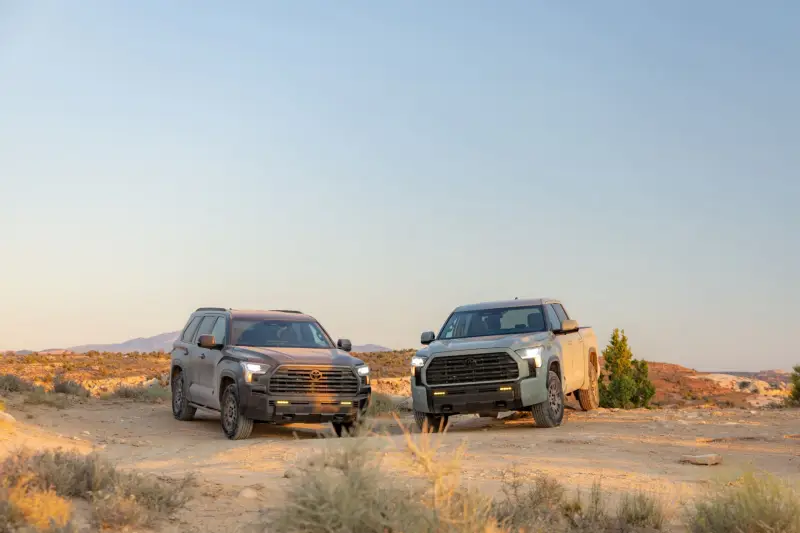
Toyota’s 2027 Tundra and Sequoia Trailhunter packages bring factory trail equipment to two larger platforms, with the first drive putting that hardware through nearly 160 miles of western Colorado and Utah terrain. The day mixed quick dirt roads with slower, rockier sections, giving the group time in each Trailhunter in the lineup. It was a useful setting for seeing how these full-size rigs fit into an overland build.
Trail equipment built around the SR5
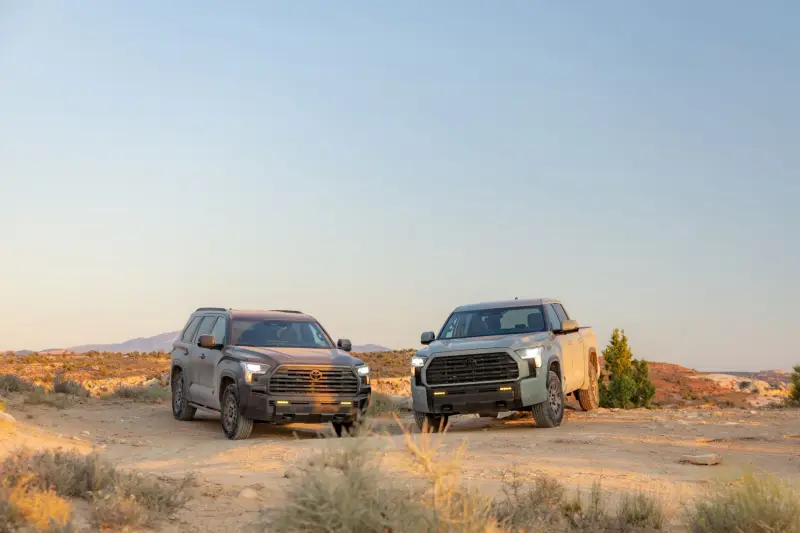
The Trailhunter setup works differently on the Tundra and Sequoia than it does on the Tacoma and 4Runner. On those smaller models, Trailhunter is a trim; on the full-size pair, it’s a package for the SR5 grade. That distinction matters when weighing the package as a starting point for an overland rig: the new parts are fitted around the SR5 rather than defining a separate grade.
Both full-size Trailhunters get Old Man Emu monotube shocks with 2-inch shock bodies and 46 mm pistons. Toyota pairs them with the SR5 springs, so the package doesn’t add ride height. That keeps the suspension recipe focused on the shock hardware rather than a taller stance. It’s a detail worth keeping in mind when considering tire clearance, approach angles or how the truck will sit once loaded: the package’s suspension upgrade doesn’t itself raise the vehicle.
The Tundra also gets a locking rear differential, 33-inch Michelin LTX Trail tires mounted on bronze wheels, aluminum skid plates and front recovery hooks. RIGID fog lights sit in a new grille with a hexagon pattern. Together, those additions address several practical needs in one factory package: traction, underbody protection, recovery points and extra lighting. The Sequoia receives the same suspension treatment and interior upgrades, though the listed equipment details for the Tundra package shouldn’t be assumed to apply identically to the SUV.
Powertrains and cabin updates
The 2027 Tundra comes standard with Toyota’s i-FORCE twin-turbo V6, rated at 389 hp and 479 lb-ft. The i-FORCE MAX hybrid is available. In the Sequoia, the hybrid is standard and produces 437 hp and 583 lb-ft. Those figures give the two vehicles different starting points under the hood: buyers choosing the Tundra can select between the standard V6 and available hybrid, while the Sequoia’s listed powertrain is the hybrid.
Every 2027 Tundra and Sequoia also gets a 14-inch touchscreen, replacing the previous 8-inch unit, along with Toyota Safety Sense 4.0 and a built-in drive recorder. For a vehicle that may spend long stretches on rough roads, the larger display is a substantial cabin change; the drive recorder adds another built-in tool for capturing time behind the wheel. The available details don’t specify transmission pairings or changes to gearing, so those are points to check against final vehicle specifications before comparing builds.
A long day in mixed terrain
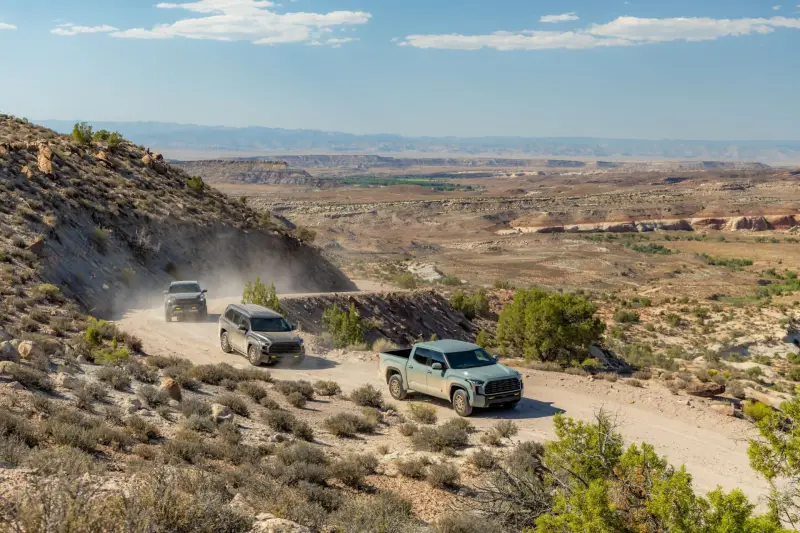
The drive covered almost 160 miles in a single day, enough distance to make the route more than a short demonstration loop. Fast dirt sections gave way to slower, rougher ground, and participants rotated through every Trailhunter in the lineup. That mix is useful for judging a setup: a shock package and tire choice have to work across changing pace and surface, not just on one polished stretch of trail.
The OLT4x4 team led the route and shared local stories along the way, including one about the Pangean woodpecker. A cave with an ancestral Puebloan handprint, verified to be thousands of years old, became the day’s standout stop. It was a reminder that a trail trip can be about more than covering ground; route planning and local knowledge can make the stops as memorable as the vehicle time.
Camp is part of the test
The group camped above 9,000 feet, with mountain views and time together after the engines were shut down. Karissa and Linhbergh of gondirtin handled the cooking, serving meal after meal. That camp setting is part of what makes an overland vehicle’s role different from a quick off-road outing: the truck or SUV has to carry people and their gear through the day, then support the slower rhythm of camp.
My read is that the 2027 Trailhunter packages give Tundra and Sequoia buyers a factory-equipped base for that kind of use, with suspension, tires and protection already part of the package. The Tundra’s unchanged SR5 springs mean the setup doesn’t add ride height, while its locking rear differential and 33-inch Michelin tires bring concrete trail hardware. The Sequoia shares the suspension treatment and interior upgrades, with its hybrid powertrain standard. Seeing both on a long, varied route offers a first look; how they perform with a full travel load will be the next useful measure.